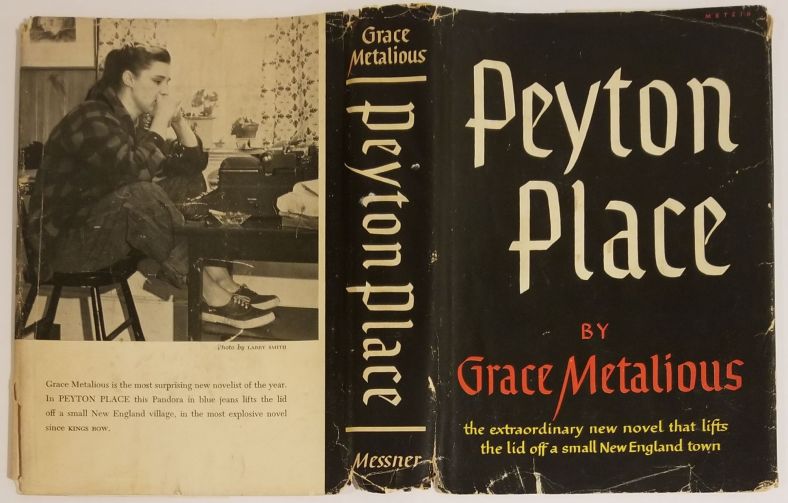

Most people have heard of the phrase “Peyton Place” and associate it with titillating scandal and soap opera. But Peyton Place began as a novel, released in 1956 by a rebellious mother and housewife who wanted to expose the hypocrisies of her hometown and her times. Sex and questioning authority in many forms shows up in her 372 page book. Unexpectedly, including to the author Grace Metalious, the characters and storyline hit a nerve in America and it was on the best-seller list for 59 weeks. At the same time a series of books put out under the Betty Crocker franchise were in the top non-fiction lists. 1 in 29 Americans bought Peyton Place. This was the Eisenhower Era when America was in the midst of its post-war economic boom and the middle class was growing and thriving. Female roles were well proscribed and Grace never fit into any of it… other than the desire to move out of the poverty she grew up in.
Controversy and Sales
If you ask people who were coming of age during that generation about Peyton Place, you will usually see a wry and somewhat pleased smile, reflecting the youthful rebellion of reading this forbidden book long ago. Colleen O’Byrne in my novel, Breathing Water, was one such person affected by the novel. Although Peyton Place was banned in many libraries, schools, and bookstores, and was illegal to ship through the mail to several countries, it sold over 12 million copies. It even outsold other popular books of its time, like Gone With The Wind. But its readership was much greater as copies were shared between school friends and mothers’ copies were ferreted out from hiding places by their youngsters. One woman I know speaks of reading it in a high school class while hiding it behind a textbook (this woman did succeed in life and became a beloved teacher, so it didn’t ruin her!).
What made this book so popular? At the time, the publisher realized its potential and decided to give it more publicity than most debut novels. Controversy sells, so they hyped up a comment by Grace Metalious that her husband, a school principal in the small town of Gilmanton, New Hampshire, would probably lose his job when it was published. Of course everyone wanted to see what was so juicy that it would cause him to be fired, and the school board helped publicity when they decided not to renew his contract shortly afterward. Word of mouth and so many organizations banning it propelled book sales followed by the involvement of the film industry. In watered down form, a movie was released in 1957 and a soap opera series from 1964 – 1969. That’s what most from the next generation vaguely recall about “Peyton Place.”
What’s so Controversial in Peyton Place?
When I read the book to see if it would be suitable for use in Breathing Water, I was surprised at how little actual sex was in the book. Sex was definitely a part of the character’s lives, as it is for most people, but there was not a lot of explicit description and the content is mild by today’s standards. Yet there were things about sex that not only caused Grace Metalious to become a millionaire, but to have a great impact on America’s sexual awareness.
Most shocking about the book was the idea of women having satisfying sexual lives. That was for loose women and whores, and yet here were nice girls not only having sex but enjoying it. Masturbation, abortion, douches not working for birth control, “safes” (condoms) that should work, and oral sex were all mentioned. One of the major characters was repeatedly raped by her step-father, showing that not all people in small town America were nice. The original story had Selina’s father raping her, but the editors thought that incest would be a bit too much for tender American eyes. In the story, Selina eventually fought back and murdered her step-father, inciting a lot of discussion about whether her act was justified.
Authors often draw from real life and this part of the book was partially based on the true story about 10 years earlier of Barbara Roberts from Grace’s town of Gilmanton, NH. She was the victim of domestic violence and incest before she killed her father and buried him under a sheep pen. Residents of the town were not pleased with Peyton Place or the Metalious family partly from a desire to protect Barbara and her family from further unwanted publicity, but also for and what it inferred about them. The book did bring the topic of incest to America’s consciousness for a short time. Sadly, more attention is needed because some statistics suggest that 1 in 3-4 girls and 1 in 5-7 boys are sexually abused before they turn 18, much of which happens from fathers or fatherly figures. Children are easily manipulated into not reporting such abuses.
Grace Metalious also included class disparities, racism, differences between Catholics and Protestants and questioning the Christian faith. There was a lot you could get upset about if you wanted to defend the status quo. All of it reflected real life—the parts no one would talk about. Grace utterly rejected the expected female behaviors of the 1950s: her home was filthy, meals were haphazard, and she was a careless mother. When she wanted to write, she kicked her three kids out of the house and told them to fend for themselves until she was done. She wore pants and flannel shirts, with her hair in a simple ponytail, instead of the bouffant hairstyles that were popular then.

A Sad Ending and Lasting Impact
After becoming a millionaire, Grace began to party hard. She spent every cent she made and then some in luxuries and heavy drinking. Interestingly, alcoholics figure large in Peyton Place and there are accurate descriptions of delirium tremens in one scene. She divorced and new friends showed up to help her spend her money. After dreaming of riches since she was a girl, Grace didn’t know how to handle it and, sadly, died at age 39 from cirrhosis of the liver. Grace Metalious was ahead of her times and helped loosen up the American psyche for others to follow. A few years later, the infamous Lolita, about a pedophile, and Lady Chatterley’s Lover, about an extramarital affair, became best sellers in the US. For many, Peyton Place was all the sex education they would get. Genuine sex education was taught in some schools in the 60s and 70s, but it wasn’t until the 1990s, during the AIDS epidemic, that it became universal. Peyton Place is actually a fast-paced and fairly well written novel (even by the standards of the literary world) and it’s still in print.
Key references and further reading:
The Peyton Place Murder- The True Crime Story Behind The Novel That Shocked The Nation by Renee Mallett (2021)
Peyton Place’s True Victim– Vanity Fair
Open Secrets: Rereading Peyton Place by Ardis Cameron, introduction to 1999 version of Peyton Place

Donna Barten is a novelist and scientist working on her second book Imprint and Inheritance.


 Donna Barten