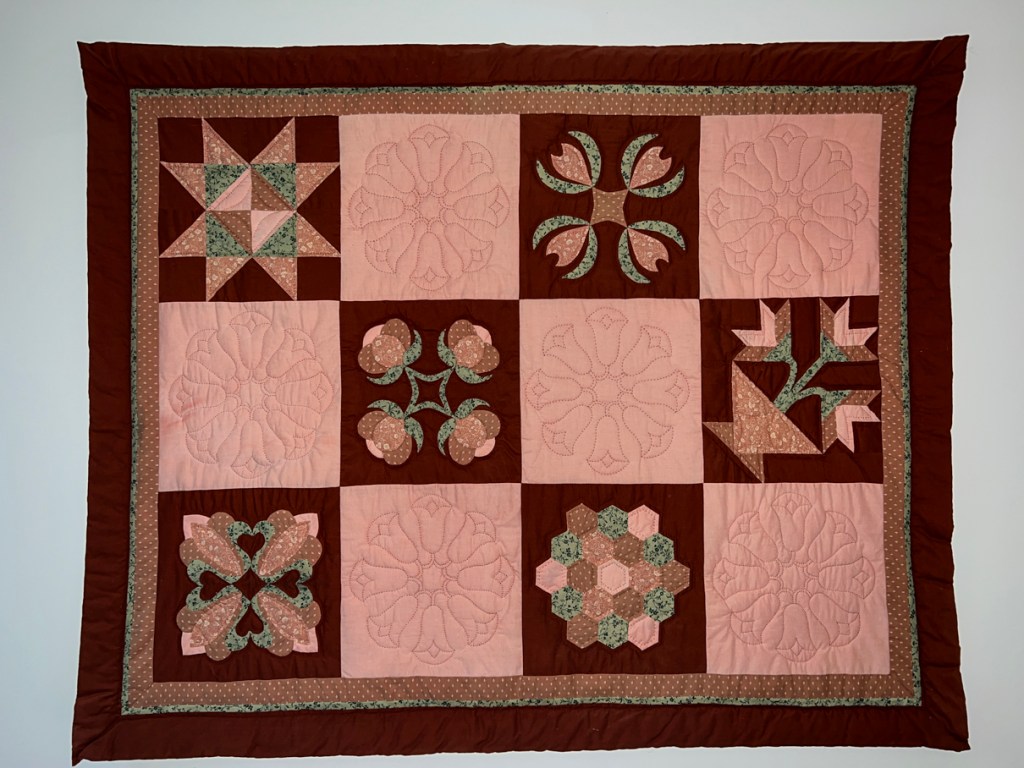
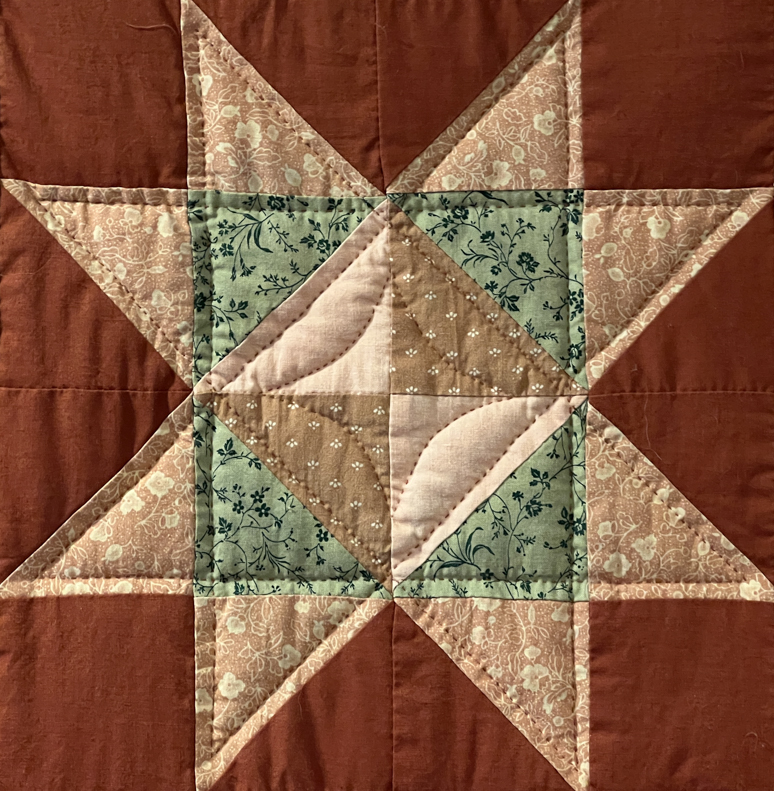
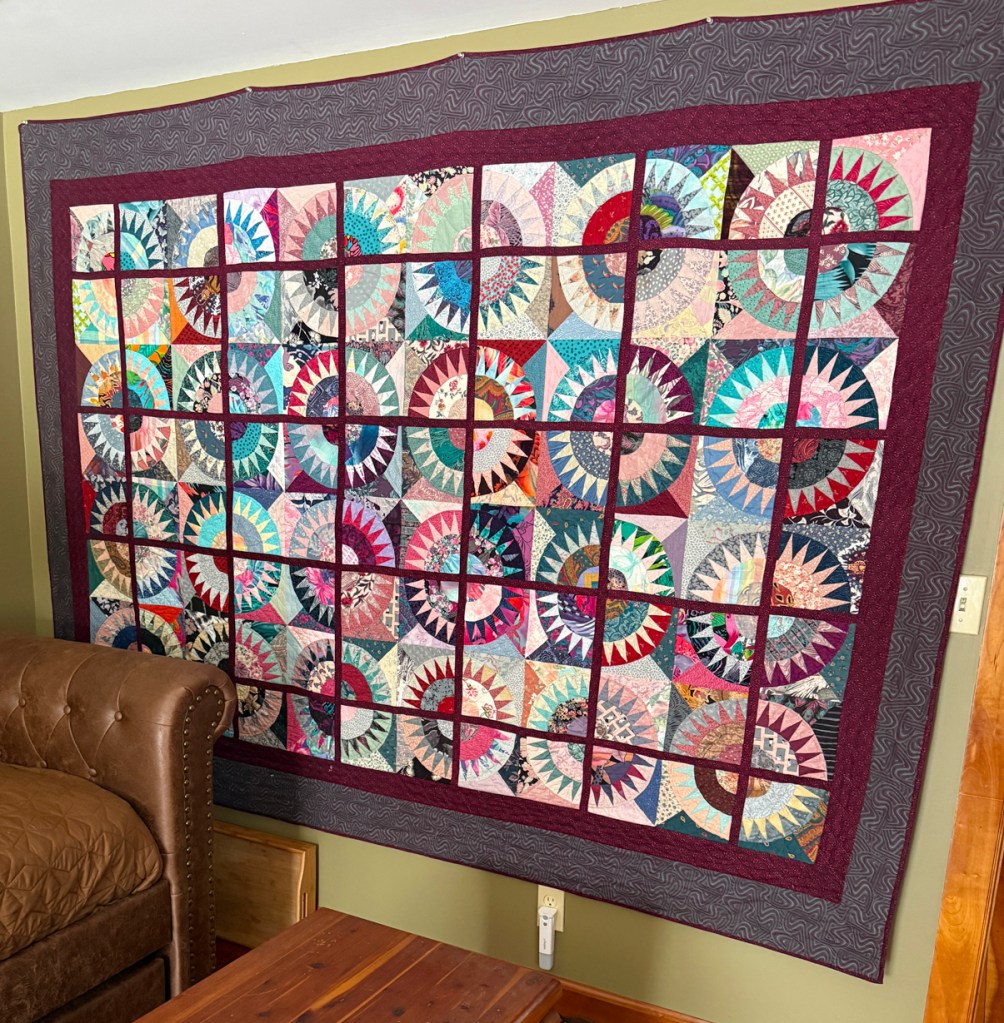
While I was a new mother attending graduate school, I yearned for some small, creative activity to soften my busy life. Because the winters are so cold in Minnesota (U of MN graduate), quilting is a big hobby. So, I signed up for a hand quilting class, and it was just what I needed—a mental and physical break without being passive. I made a baby sized quilt that was too good to ever put near a spitting-up baby, but it has hung in my home ever since, a constant reminder of my daughter and the joy of becoming a mother.
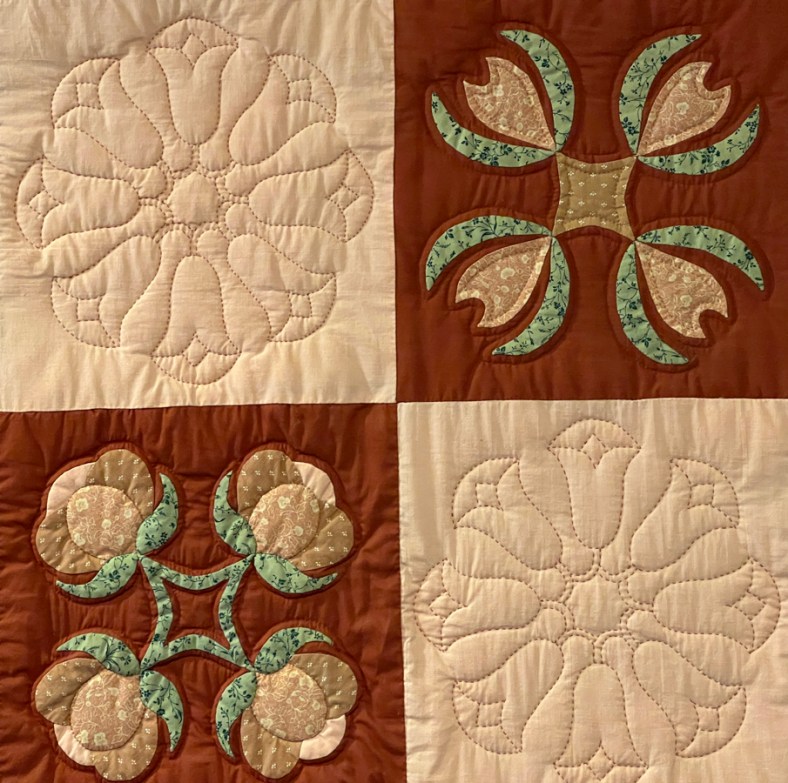
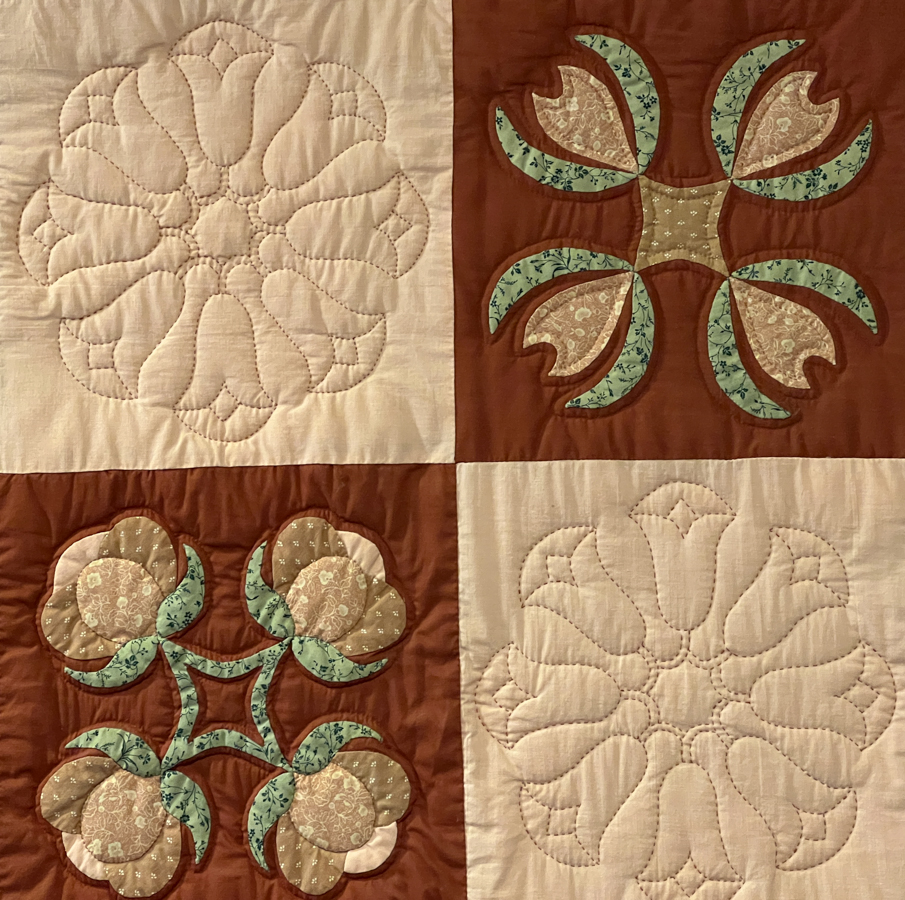
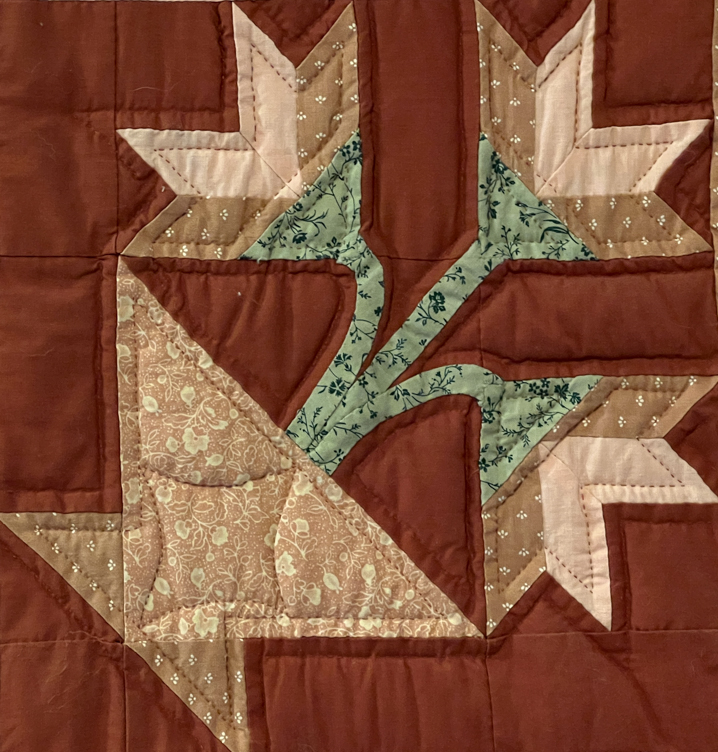
Patchwork quilts usually have repeating fabrics, colors and designs, and in this quilt, the light orange squares all have the same pattern of a circle of bell flowers. In the darker squares, we learned different techniques, so those designs are all different. But look closely and you will see a stylized (pinched) square shape in the center of the symmetrical flower designs (left). Our instructor asked us to look for places to repeat a pattern in each of the other squares, and I was able to fit that stylized square into all but one of the darker squares through quilting. On the right you can see two squares where I’ve repeated that element.
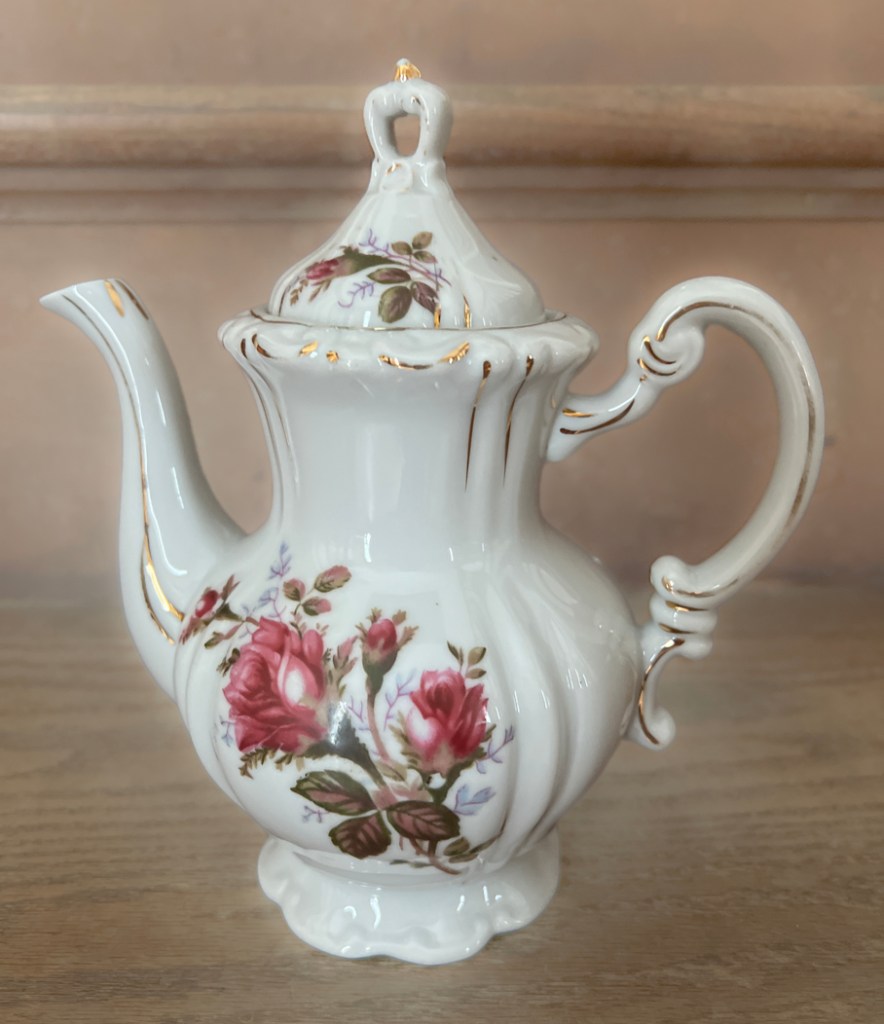
While I was looking at that quilt one day, I realized that these repeating elements were similar to writing. You work on your basic story and there are innumerable revisions and improvements once you’ve got that story down. You add details to enhance the readers experience, and—you got it—you repeat some of the details to create more of a cohesive whole to the story. One way I’ve done that in my latest novel is with roses. I didn’t start doing it on purpose, but I had this teapot and it happened organically.
The teapot was inherited from my mother. It had belonged to her mother. It was a natural to add to the story and link the three generations of women who inhabit Imprint and Inheritance. I happen to like roses, so they worked their way into the story in other ways. Once I noticed the pattern, I made it intentional, like the stylized square shapes in my first quilt, to enhance the texture of the story. It’s those little details that enrich our lives and those of our characters. Below are some roses that have bloomed in my garden.
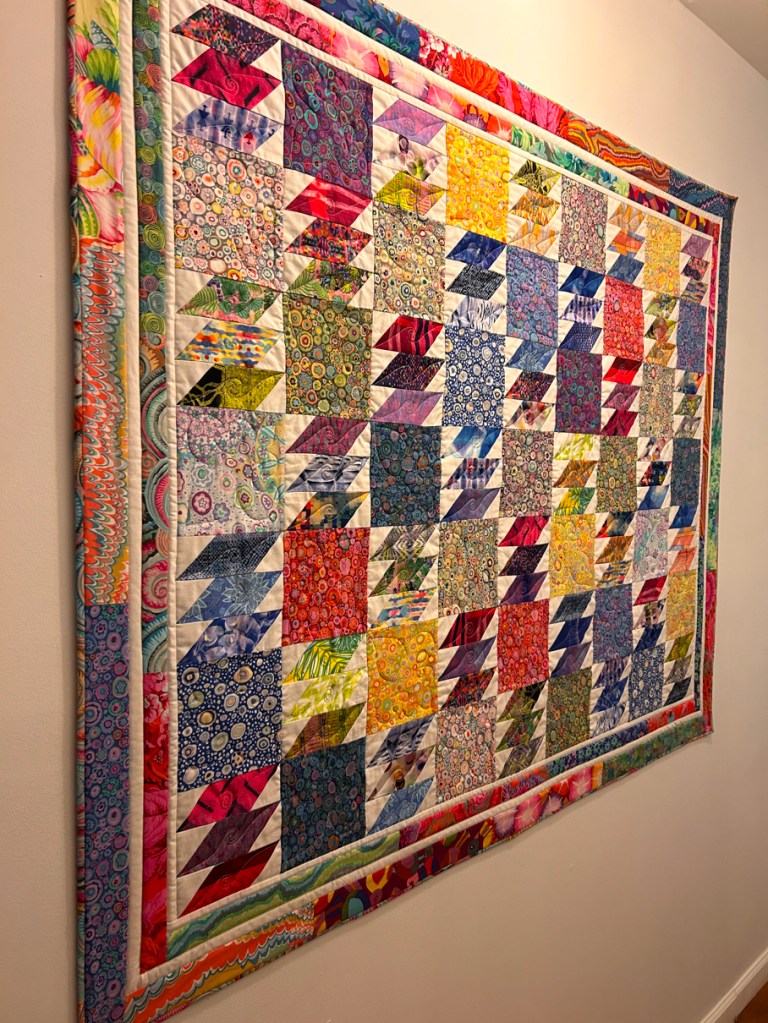
I haven’t done much patchwork and quilting since then, but always enjoy looking at the artwork of others. Here’s a few made or owned by people I know.
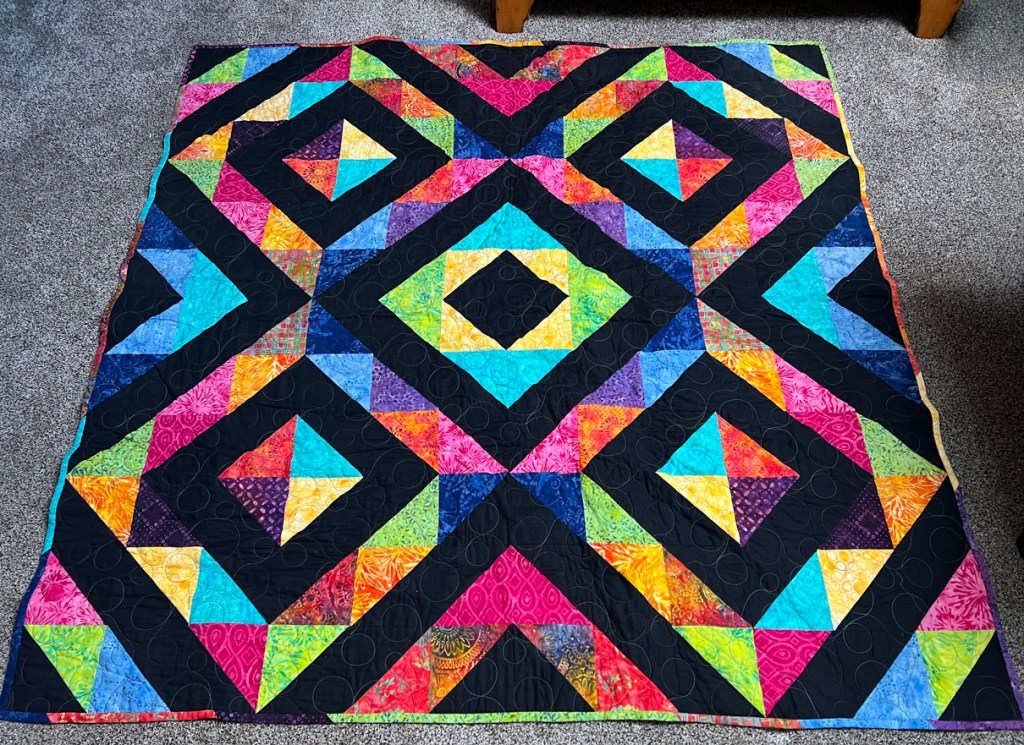
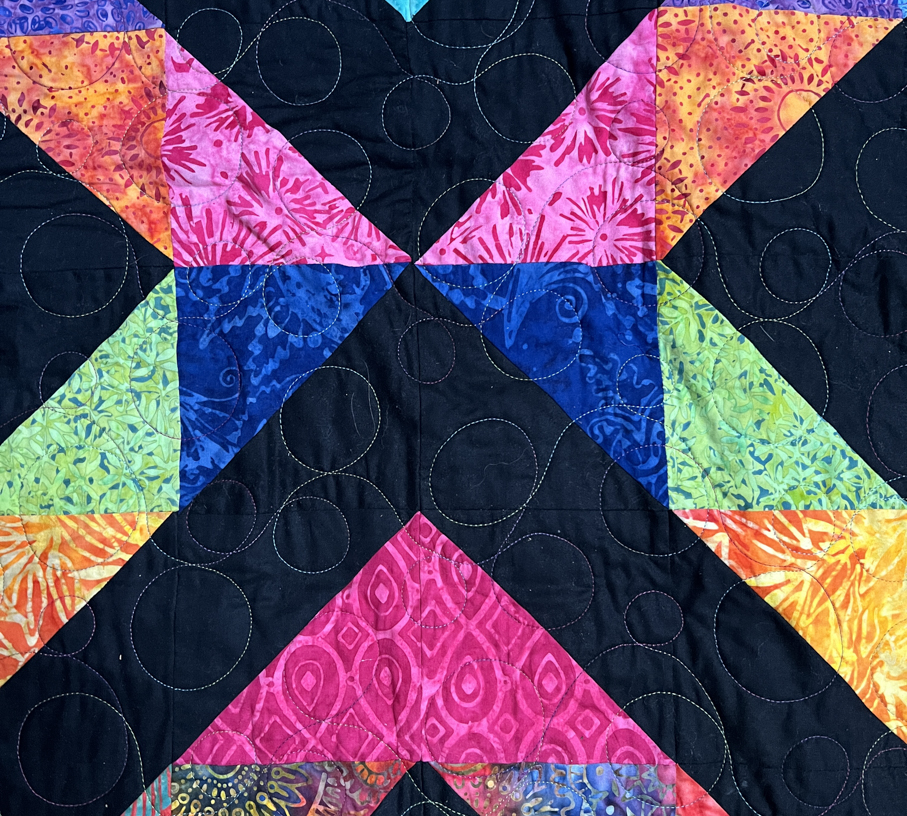
My friend BJ Jackson made this quilt for me as an amazing surprise gift. I was blown away by the contrast of the bright colors with the black geometric shapes. Note how she used different fabric patterns, but often with the same colors (ie pinks) to enrich the piece with repeating elements of color. This quilt lives in my writing space for inspiration.
This beautiful quilt is owned by Lise and Bob Howe, and was created by Bob’s mother, Nancy Tongue Howe in 1995. Notice how the strong repeated pattern and solid grid allows the quilt to use a plethora of different fabrics to great effect.
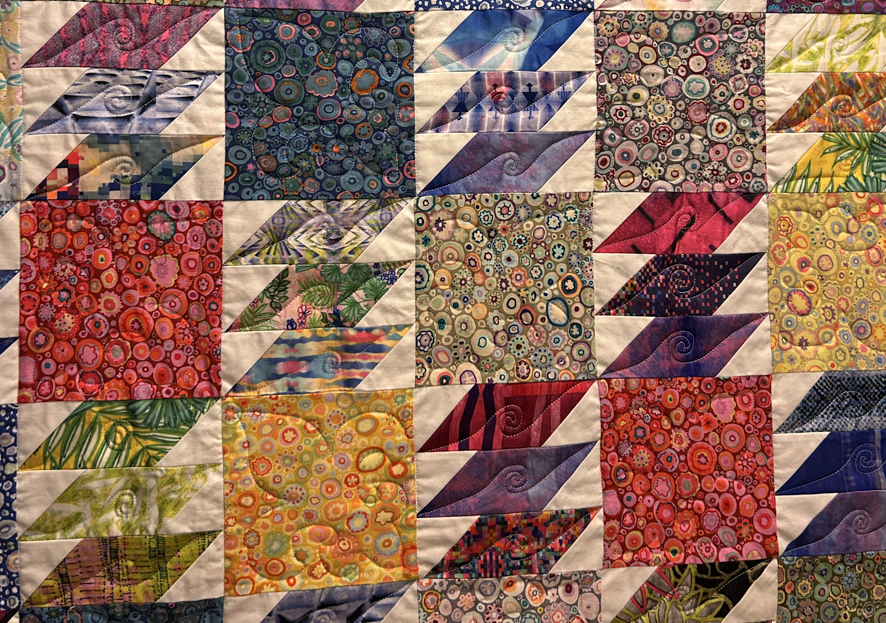
This quilt was crafted by Joann Blackmore to highlight fabric designed by my now grown daughter, Ellen Tips. The small parallelograms are Ellen’s fabrics, and Joann pulled it all together by using larger blocks of different colors, but with similar circular/floral designs. The shape and pattern repeating elements pull the whole thing together.
Next time you read a book, see if you can identify some repeating elements that may be adding depth and meaning to the storyline. Let me know what you see.
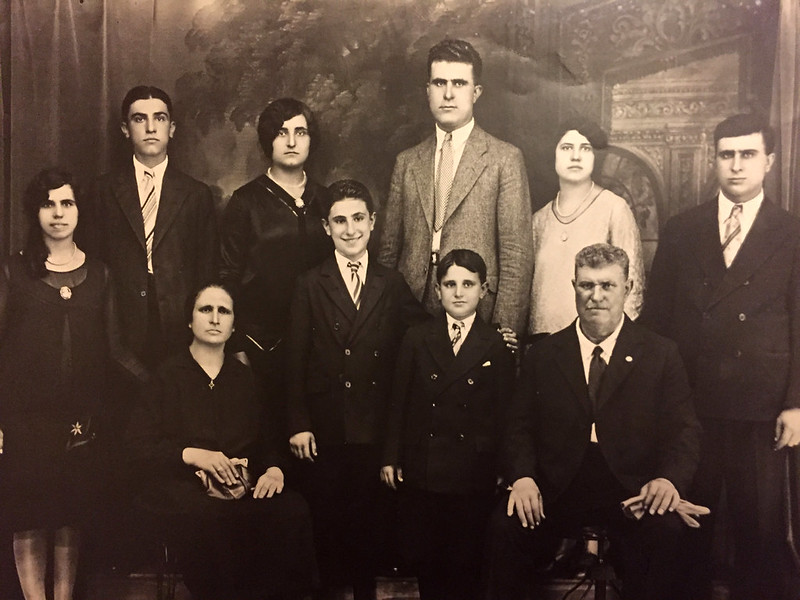
Old photographs figure large in my second novel, Imprint and Inheritance. Colleen shows Julia old photos from 1920 – 1960 to reminisce, and one particular photo is the inciting incident for the novel. Most were black and white, but the earliest photos were sepia-toned. As I wrote, I wondered if black-and-white photos turned sepia with age, or if they were created that way.
The word sepia comes from the Greek word for an ink extracted from European common cuttlefish (Sepia officinalis), of the reddish-brown hue. Turns out these are fascinating animals. Since cuttlefish squirt ink and camouflage themselves by moving pigment to different parts of their body, it made sense for early cultures to extract ink for their own use.
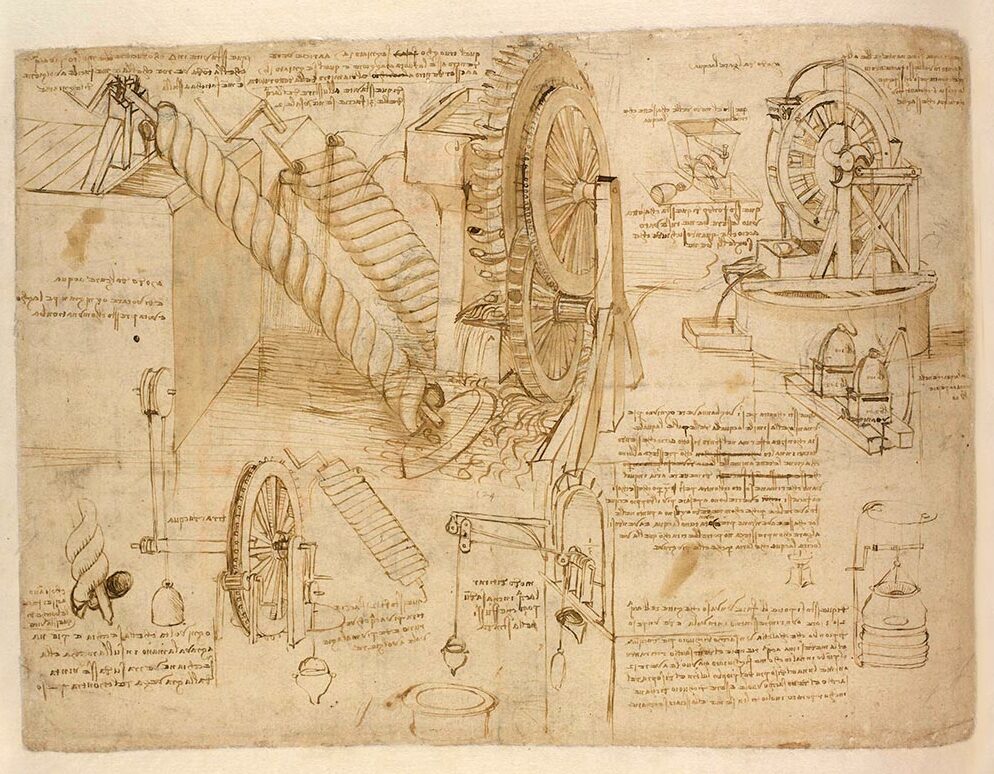
Sepia ink was used by writers and artists for centuries, including by Leonardo DaVinci.
It turns out sepia toning was a separate step while printing photographs from the 1880s to the early 1900s. The photos started out black and white, but were toned to sepia by the photographer before the customer ever saw it. Not only did Sepia toning make the images warmer and more inviting (increasing in warmth with aging), but it fixed the photographic image on the paper for 50% longer. Because photographs were a luxury items and families usually had just a few to record their whole lives, reduced fading was worth the extra step.
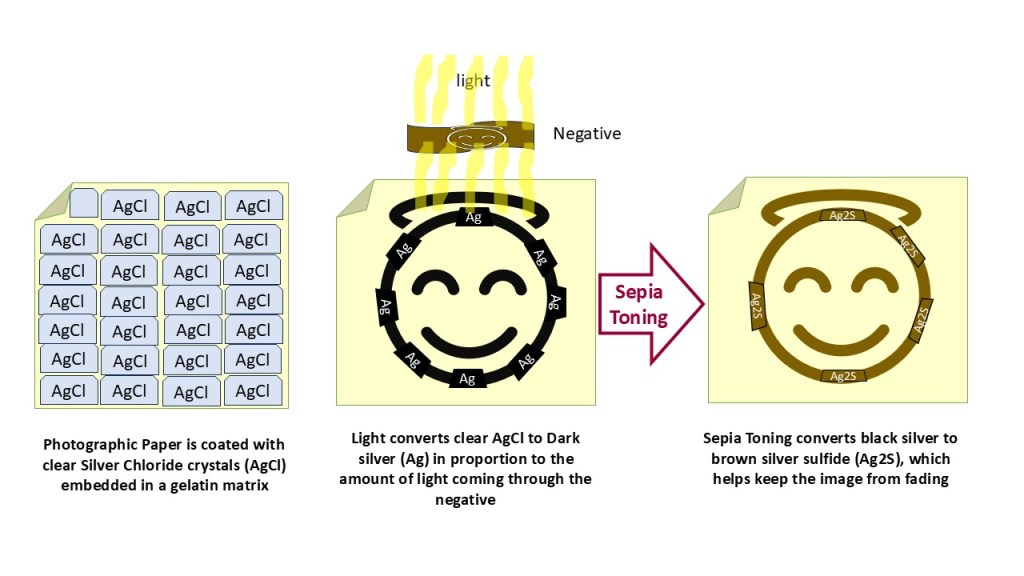
Interestingly, the toning process can be done in the daylight once the prints are made in the darkroom. Initially, that was helpful when sodium sulfide was used, as it’s what gives rotten eggs their odor. Here’s a basic diagram of how silver particles (embedded within gelatin on the paper surface) are transformed during printing and sepia toning.
Nowadays film hobbyists and artists use thiourea for sepia toning, which doesn’t smell as much, but it’s still better used outside of the darkroom. Here’s a demo video if you’re curious how it’s done.
As photographic processes improved over time, sepia toning was no longer necessary to stabilize the image. As a result, black-and-white photos dominated from the 1930s through the 1960s. Color photography was available as early as the 1930s, but was not as common as hand coloration of black-and-white photos. In the 1970s, color dominated the printing market when it became more affordable.
Hand colored black-and-white photo of my father as a boy, approx 1944
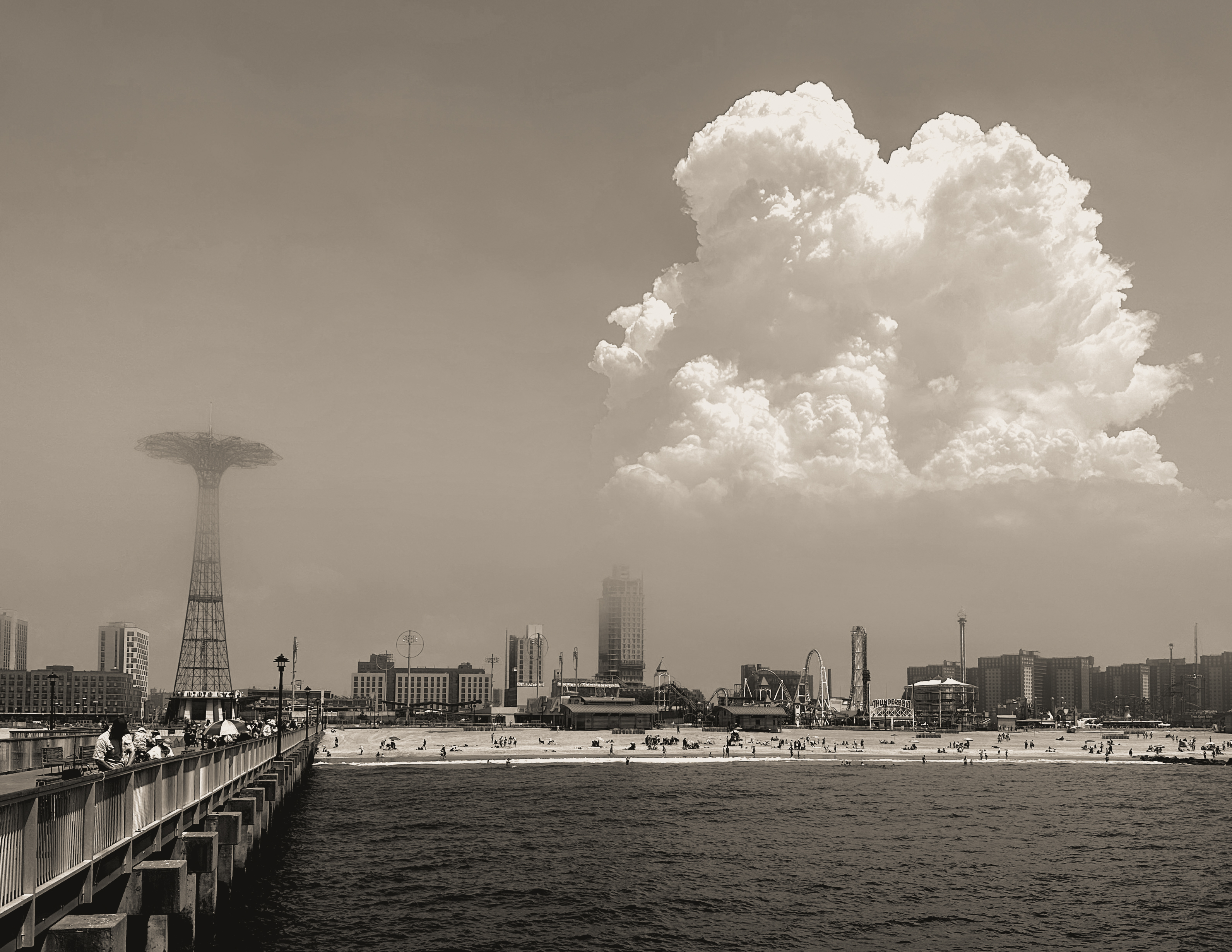
Photographers still do sepia toning for artistic reasons, adding just a hint of sepia to a black-and-white photo, or completely converting to sepia of different intensities and tonalities. But because of its history, sepia tones evoke a sense of nostalgia. Nowadays you can create sepia toned images on your digital camera, with a bit of finessing on your smartphone, or after the fact using Lightroom/Photoshop with the click of a few buttons.
Coney Island- 2023- Click to switch to black-and-white or sepia-tone. Which gives the greatest atmosphere of an earlier time?
Note: Photos are from the author’s family collection and may not be used without permission. The DaVinci image is from the public domain at Wikipedia.
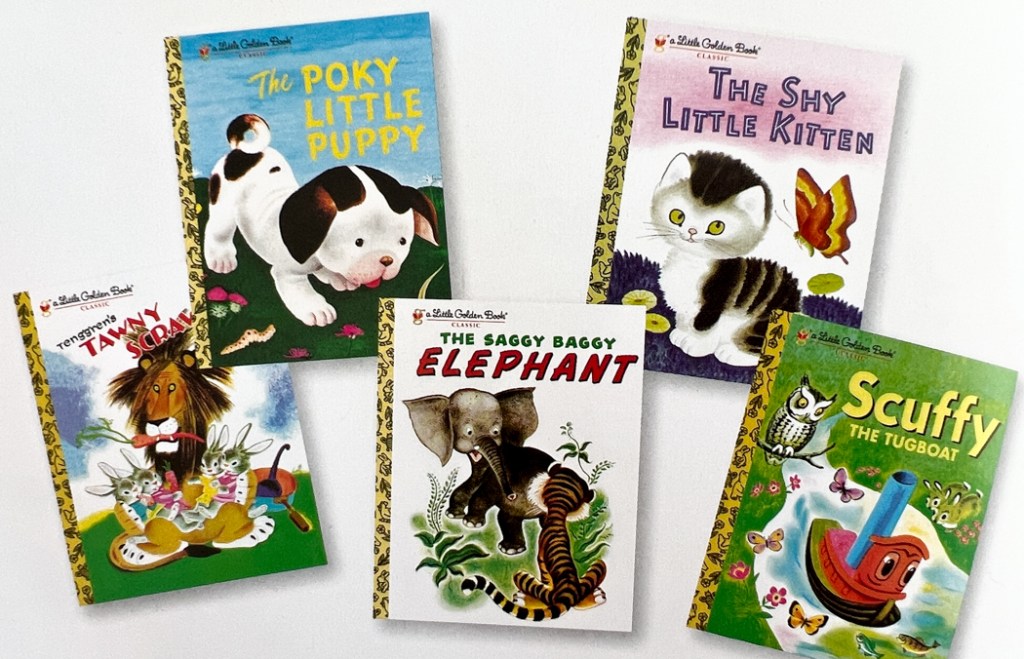
Do you remember reading Little Golden Books when you were a child, or reading them to children and even grandchildren? This institution of American children’s books began in 1942 during World War II and, after 82 years, it’s been read by generations of children. In 2013, the Smithsonian even put together a special exhibit about Golden Books.
In 1942, most children’s books were $2 – 3, out of the price range of the average family when food price inflation was rampant due to the start of hostilities. In 1942, a pound of coffee cost 28 cents and a pound of ground beef was 30 cents. First published in a collaboration of Simon and Schuster with Western Publishing, Golden Books were priced at 25 cents each, sold in places where children would be with their mothers, such as supermarkets and drugstores. With inflation, that would be $4.73 now, which is pretty close to the current selling price of $4.99. The publishers felt they could make enough money at the 25 cent price point if they sold 50,000 copies. They started with 12 titles released together. All had 42 pages with 28 in 2 color and 14 in three color. They tapped into an unrecognized demand, because in the first 5 months they sold 1.5 million books! Among the first 12 books were The Pokey Little Puppy, The Little Red Hen and The Three Little Kittens. See the rest of the list here.
The Pokey Little Puppy, still in print, was so popular that it was the highest selling children’s book of the 20th century, with almost 15 million copies sold. By the way, did you know there is a NY Times Best Seller List for Children’s picture books? Check it out here. The current best seller is Dragons Love Tacos.
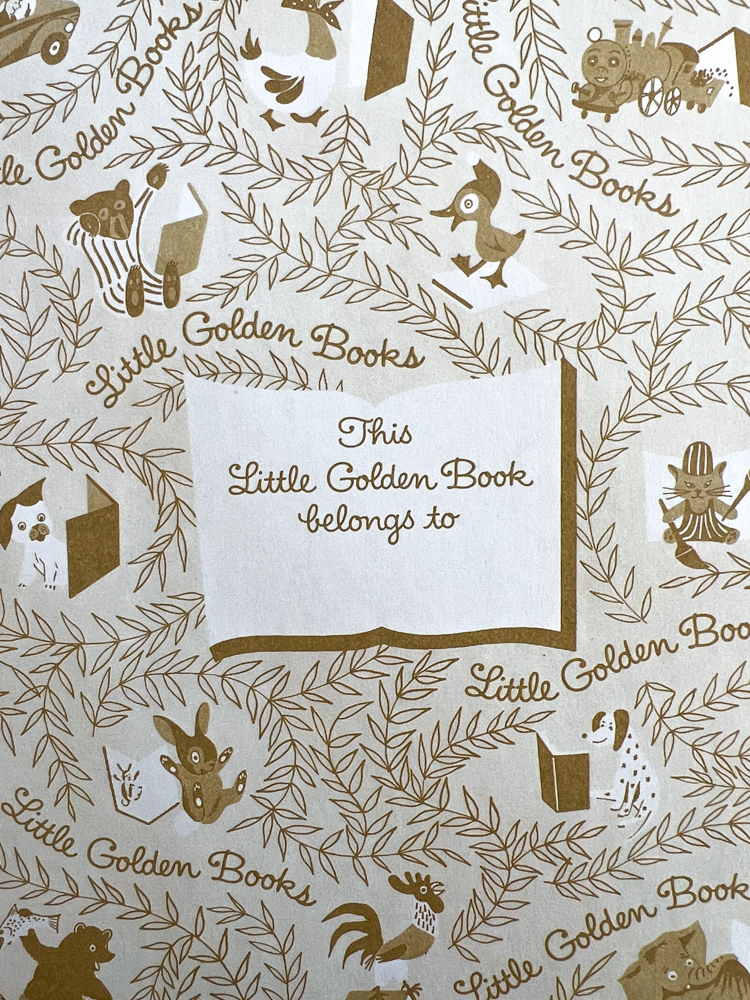
The first books were small in size and intended to be a child’s possession. Later editions included a variety of sizes. Inside the front cover of every book was an invitation to mark it as each child’s own.
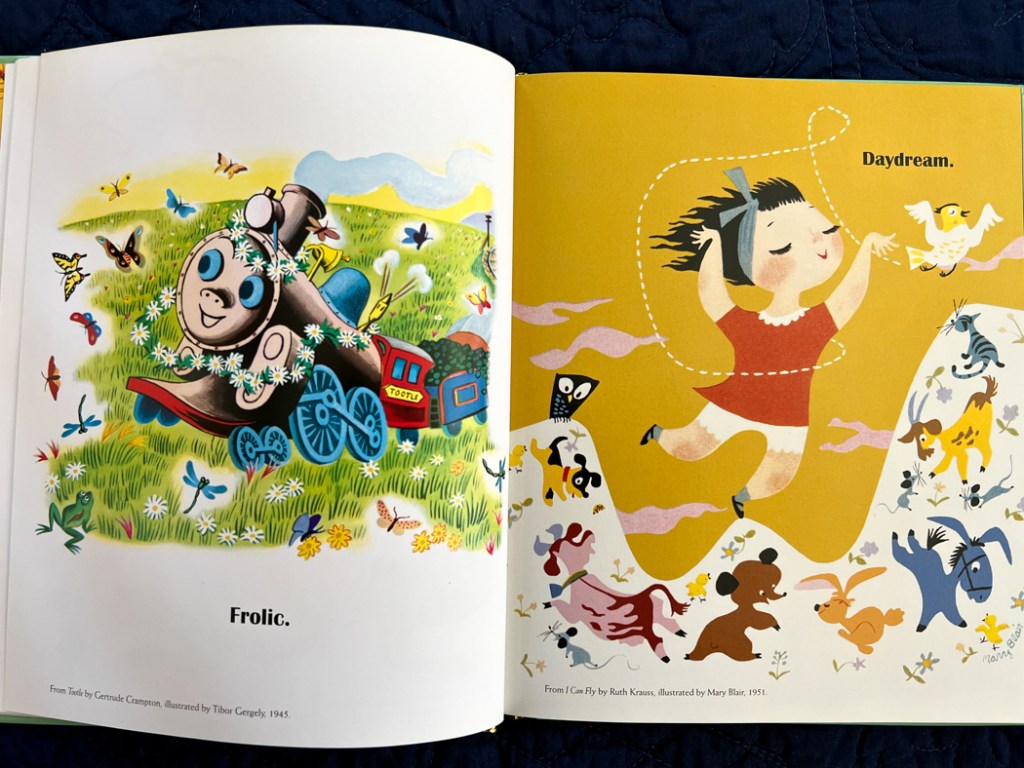
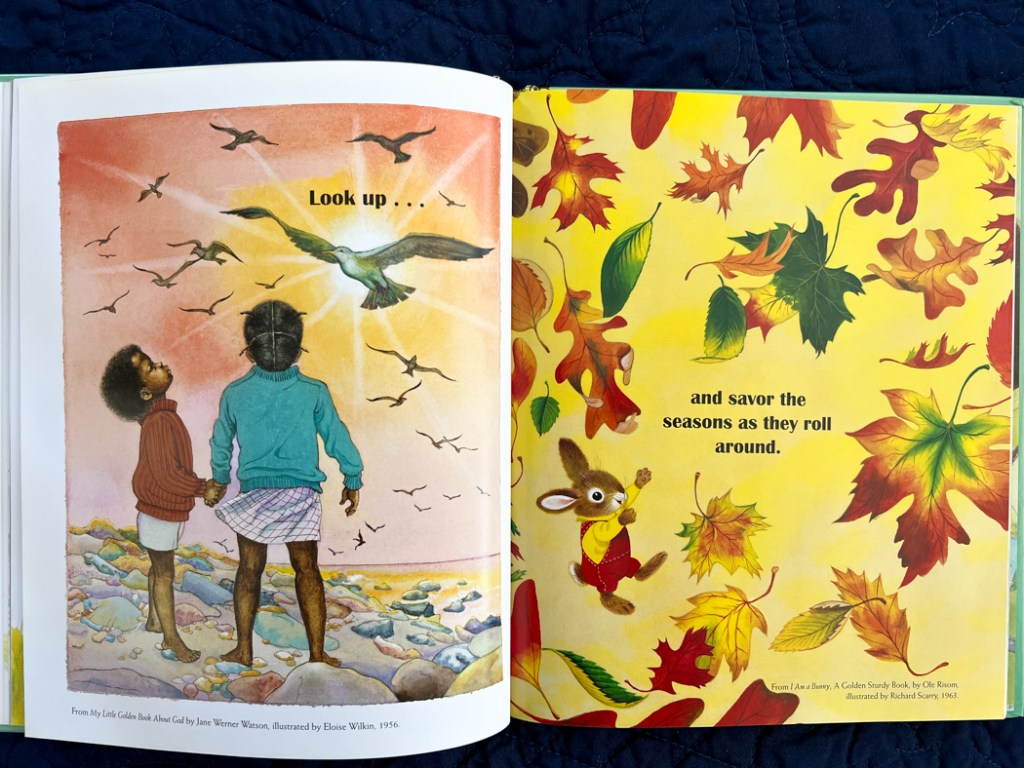
And of course, there is the distinctive gold or silver foil binding with line drawings on it. I still remember being fascinated with how fancy that was as a child. Famous children’s book authors and illustrators who contributed to Golden Books were: Richard Scarry, Margaret Wise Brown, and Garth Williams (illustrated Charlotte’s Web and the Little House Series).
Golden Books quickly incorporated cartoon characters, Sesame Street, Marvel comic heroes and Disney characters in their line up, as well as animal and vehicle characters—whatever was popular with kids at the time in their daily lives, reading, TV and movie exposure. In 2001, the Golden Book franchise was sold to Random House and they continue to find new avenues to reach children. The current most popular series are the biographies, with Taylor Swift’s biography of 2023 the fastest growing Golden Book ever—selling 1 million copies in 7 months!
In my novel Imprint and Inheritance, Fiana focuses extra attention on early education for her girls after nearly completing a teaching certificate. Even though Fiana struggled with schizophrenia, she tried hard to be a good mother to her children. Golden Books in Fiana’s home were a natural for current readers to relate to and I enjoyed learning more about them as research for the book. Hope you enjoyed learning more about them too!
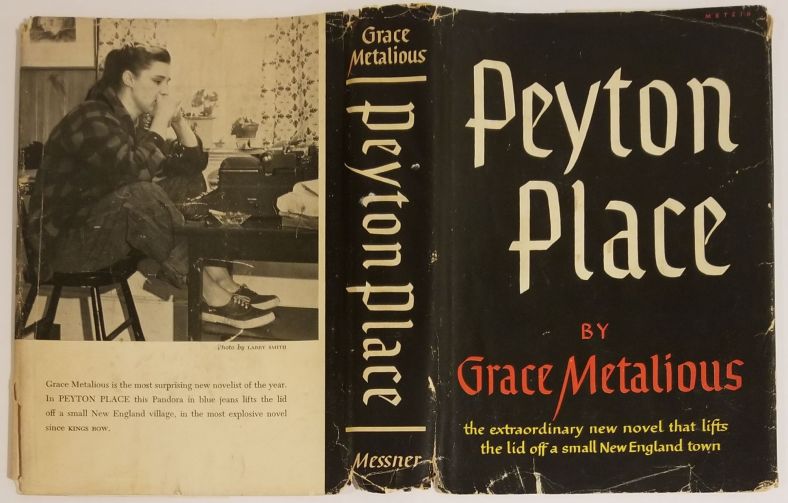
Most people have heard of the phrase “Peyton Place” and associate it with titillating scandal and soap opera. But Peyton Place began as a novel, released in 1956 by a rebellious mother and housewife who wanted to expose the hypocrisies of her hometown and her times. Sex and questioning authority in many forms shows up in her 372 page book. Unexpectedly, including to the author Grace Metalious, the characters and storyline hit a nerve in America and it was on the best-seller list for 59 weeks. At the same time a series of books put out under the Betty Crocker franchise were in the top non-fiction lists. 1 in 29 Americans bought Peyton Place. This was the Eisenhower Era when America was in the midst of its post-war economic boom and the middle class was growing and thriving. Female roles were well proscribed and Grace never fit into any of it… other than the desire to move out of the poverty she grew up in.
Controversy and Sales
If you ask people who were coming of age during that generation about Peyton Place, you will usually see a wry and somewhat pleased smile, reflecting the youthful rebellion of reading this forbidden book long ago. Colleen O’Byrne in my novel, Breathing Water, was one such person affected by the novel. Although Peyton Place was banned in many libraries, schools, and bookstores, and was illegal to ship through the mail to several countries, it sold over 12 million copies. It even outsold other popular books of its time, like Gone With The Wind. But its readership was much greater as copies were shared between school friends and mothers’ copies were ferreted out from hiding places by their youngsters. One woman I know speaks of reading it in a high school class while hiding it behind a textbook (this woman did succeed in life and became a beloved teacher, so it didn’t ruin her!).
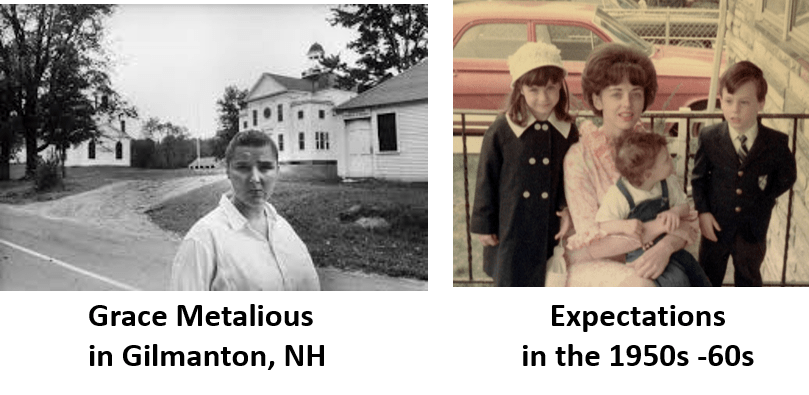
What made this book so popular? At the time, the publisher realized its potential and decided to give it more publicity than most debut novels. Controversy sells, so they hyped up a comment by Grace Metalious that her husband, a school principal in the small town of Gilmanton, New Hampshire, would probably lose his job when it was published. Of course everyone wanted to see what was so juicy that it would cause him to be fired, and the school board helped publicity when they decided not to renew his contract shortly afterward. Word of mouth and so many organizations banning it propelled book sales followed by the involvement of the film industry. In watered down form, a movie was released in 1957 and a soap opera series from 1964 – 1969. That’s what most from the next generation vaguely recall about “Peyton Place.”
What’s so Controversial in Peyton Place?
When I read the book to see if it would be suitable for use in Breathing Water, I was surprised at how little actual sex was in the book. Sex was definitely a part of the character’s lives, as it is for most people, but there was not a lot of explicit description and the content is mild by today’s standards. Yet there were things about sex that not only caused Grace Metalious to become a millionaire, but to have a great impact on America’s sexual awareness.
Most shocking about the book was the idea of women having satisfying sexual lives. That was for loose women and whores, and yet here were nice girls not only having sex but enjoying it. Masturbation, abortion, douches not working for birth control, “safes” (condoms) that should work, and oral sex were all mentioned. One of the major characters was repeatedly raped by her step-father, showing that not all people in small town America were nice. The original story had Selina’s father raping her, but the editors thought that incest would be a bit too much for tender American eyes. In the story, Selina eventually fought back and murdered her step-father, inciting a lot of discussion about whether her act was justified.
Authors often draw from real life and this part of the book was partially based on the true story about 10 years earlier of Barbara Roberts from Grace’s town of Gilmanton, NH. She was the victim of domestic violence and incest before she killed her father and buried him under a sheep pen. Residents of the town were not pleased with Peyton Place or the Metalious family partly from a desire to protect Barbara and her family from further unwanted publicity, but also for and what it inferred about them. The book did bring the topic of incest to America’s consciousness for a short time. Sadly, more attention is needed because some statistics suggest that 1 in 3-4 girls and 1 in 5-7 boys are sexually abused before they turn 18, much of which happens from fathers or fatherly figures. Children are easily manipulated into not reporting such abuses.
Grace Metalious also included class disparities, racism, differences between Catholics and Protestants and questioning the Christian faith. There was a lot you could get upset about if you wanted to defend the status quo. All of it reflected real life—the parts no one would talk about. Grace utterly rejected the expected female behaviors of the 1950s: her home was filthy, meals were haphazard, and she was a careless mother. When she wanted to write, she kicked her three kids out of the house and told them to fend for themselves until she was done. She wore pants and flannel shirts, with her hair in a simple ponytail, instead of the bouffant hairstyles that were popular then.
A Sad Ending and Lasting Impact
After becoming a millionaire, Grace began to party hard. She spent every cent she made and then some in luxuries and heavy drinking. Interestingly, alcoholics figure large in Peyton Place and there are accurate descriptions of delirium tremens in one scene. She divorced and new friends showed up to help her spend her money. After dreaming of riches since she was a girl, Grace didn’t know how to handle it and, sadly, died at age 39 from cirrhosis of the liver. Grace Metalious was ahead of her times and helped loosen up the American psyche for others to follow. A few years later, the infamous Lolita, about a pedophile, and Lady Chatterley’s Lover, about an extramarital affair, became best sellers in the US. For many, Peyton Place was all the sex education they would get. Genuine sex education was taught in some schools in the 60s and 70s, but it wasn’t until the 1990s, during the AIDS epidemic, that it became universal. Peyton Place is actually a fast-paced and fairly well written novel (even by the standards of the literary world) and it’s still in print.
Key references and further reading:
The Peyton Place Murder- The True Crime Story Behind The Novel That Shocked The Nation by Renee Mallett (2021)
The Nazi Party embraced an ideology of purifying their population from anyone deemed genetically inferior—to create a master race that would take their “rightful place” as the masters of Europe. It was at the top of Hitler’s agenda and he and his henchmen worked hard to make it happen. Although much has been published on the concentration camps that sterilized and exterminated European Jews, along with gypsies, homosexuals and other “undesirables,” most people don’t know about the preceding systematic sterilization and, finally, execution of the mentally ill.
By the time Hitler came to power in 1933, the field of Eugenics was firmly established in Europe, the United States and other nations. It was based on the faulty extension of Darwin’s work to humanity, initially promoted by Sir Francis Galton, Darwin’s cousin, in 1883. Mental disorders, and particularly schizophrenia, were believed to be genetically transmitted as a Mendelian recessive gene in the population. Nazis reasoned that if those with these disorders or other imperfect characteristics were prevented from reproducing, then these genes would disappear from the general population.
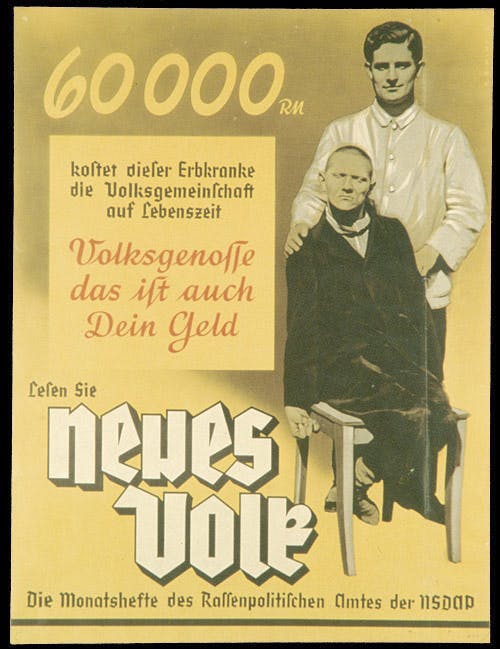
Part of the justification for later “euthanasia,” endorsed by many prominent psychiatrists in both Europe and the US, was economic. Educational campaigns in Germany emphasized how much each mentally ill patient cost the government and the taxpayers, especially between the World Wars when cash-strapped Germany was suffering from economic retribution by the victors of WWI.
This poster promoted the Nazi magazine Neues Volk, the caption reads: “This hereditarily ill person will cost our national community 60,000 Reichsmarks over the course of his lifetime. Citizen, this is your money.” 1938
US Holocaust Museum, Public Domain
The eugenics field recommended sterilization of the mentally ill and it became common practice in many Western countries. In the US, Indiana required it by law in 1907, and by the 1930s the majority of states followed suit. Heinous forced and improperly disclosed sterilizations were also performed by the US government on Black, Puerto Rican and Native American women through the 1970s with the express purpose of reducing their populations.
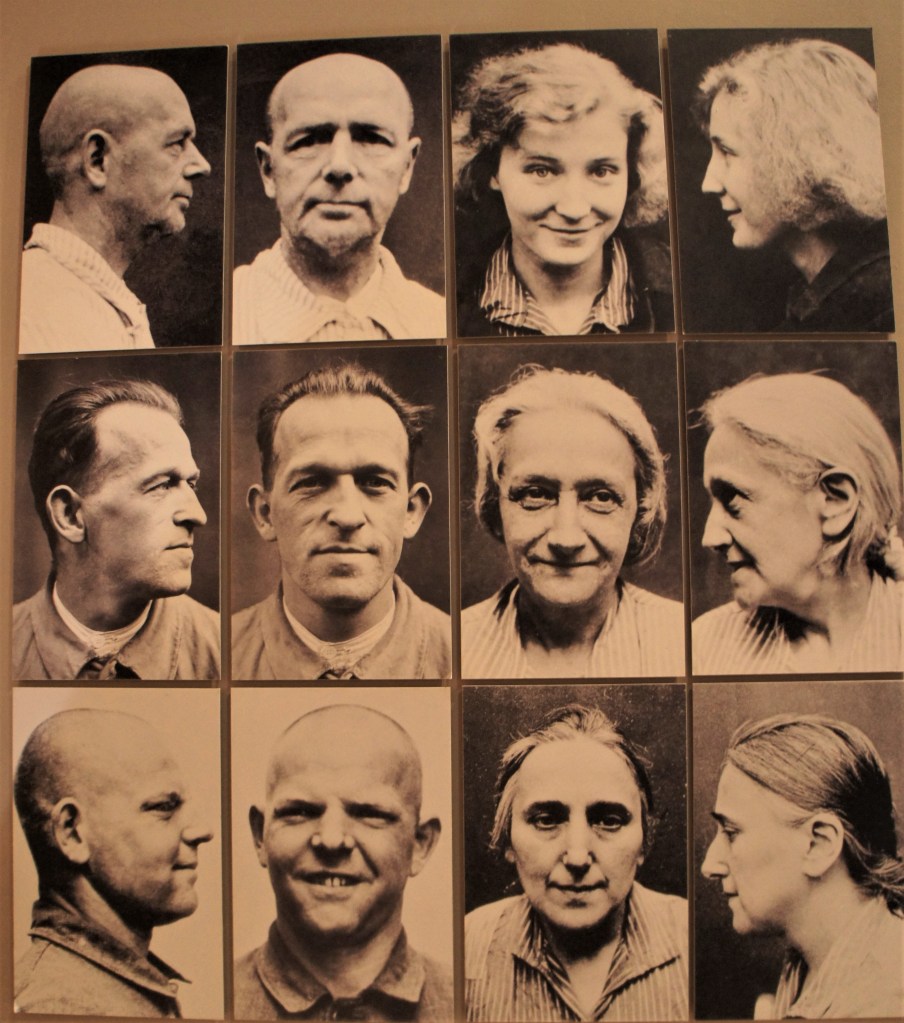
The Nazi regime in Germany became fanatical about eugenics and racial purity, taking it further than any other country. They required psychiatrists to fill out forms about all their patients to provide a database of those who should be prevented from reproducing. Many psychiatrists enthusiastically supported the government policy and the Law for the Prevention of Hereditary Diseased Offspring was passed in 1933. Approximately 400,000 Germans, many living in the community, were subjected to involuntary sterilization. An estimated 26% had schizophrenia.
Hitler and his cronies wanted to take it further, but they knew they had to be careful of public opinion, even in Germany. The quiet authorization of the T4 program to murder mental health patients was signed by Hitler himself. It was backdated to September 1, 1939, the start of WWII and the invasion of Poland, in order to link the order with the war. They were judged as “useless eaters” having “life unworthy of life.” “As the fanatical Dr. Pfannuller in the Nazi program put it: ‘The idea is unbearable to me that the best, the flower of our youth must lose its life at the front in order that feebleminded and irresponsible asocial elements can have a secure existence in the asylum.’” (The Nazi Doctors by Robert Jay Lifton) Using the records collected earlier, 70,273 patients in mental hospitals were exterminated in the program.
In order to expedite the execution of so many people in such a short period of time, the German authorities invented fake shower rooms for the administration of carbon monoxide to kill a groups of compliant and unsuspecting patients. When the program was dismantled, many of the psychiatrists and other workers were transferred to the concentration camps where they continued to refine this “efficient” method of mass execution.
There were German psychiatrists and doctors whose job it was to make up medical reasons to put on the death certificates of these murdered patients, because the Nazis knew it would not be popular and they loved orderly paperwork. After families began noticing the link between having their loved one transferred to a new facility, then getting a death notice shortly afterward, protests began, including by Catholic and Protestant churches.
As a result, the formal T4 executions were ended in August 1941, but the killing didn’t stop for psychiatric patients, it just changed form. Institutionalized patients were divided into two groups and given two different diets. Those who could work for the state were given a diet with minimal calories and those who could not were given starvation diets. And starve they did. In the end, 200,000 to 275,000 patients with schizophrenia were eliminated. That was estimated as 70 – 100% of the schizophrenic population in Germany and was expected to reduce or eliminate transmission of the disease to the next generation.
But the evil intentions of the Nazis failed in this as well. Yes, after the war there was a very low incidence of schizophrenia because the individuals from that generation had been killed, but in the succeeding generation, there was an INCREASED incidence of schizophrenia in the population relative to other countries and the previous historical rate.
How can that be? Well it turns out that schizophrenia arises from a complex interplay of genetic and environmental factors. Rather than a single recessive gene causing the disease, there are hundreds, or even thousands, of genes that slightly increase susceptibility to the disease, and these genes are widely distributed within the population. So although there is an increased risk of someone being diagnosed with schizophrenia if they have a relative with the disease, the risk is still pretty low. Even for identical twins, with identical genes, the chances of the second twin getting the disease if the first one has it, is only ~50%. So it would have been impossible for the Nazis, or anyone else for that matter, to eliminate the gene pool that lends susceptibility to schizophrenia.
Also, if you consider environmental factors, things were pretty grim for the German populace after WWII. There was famine, disease and widespread poverty, as well as the humilation of a second defeat in war. That is the most likely reason more individuals with potentially susceptible gene combinations were affected in utero and during their life experiences to develop schizophrenia. Thankfully, after the war and the atrocities of the Nazis came to light, eugenics was abandoned by the Western World. The hubris of these scientists and psychiatrists led to immense evil because they forgot their humanity and did not have the humility to understand they could be wrong, and they were.
Donna Barten is a novelist and scientist working on her second book Imprint and Inheritance.
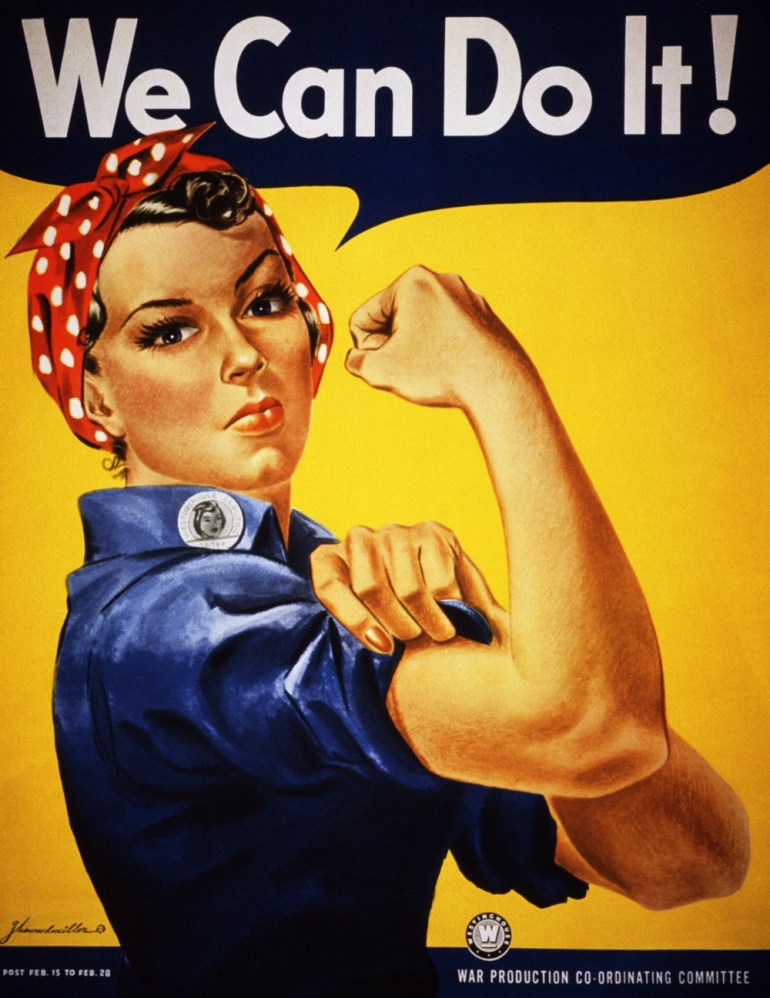
This Rosie the Riveter image is widely recognized as a symbol of female empowerment and the feminist movement. It was originally a poster made to encourage the newly working women at the Westinghouse Electric and Manufacturing Company during WWII. The poster was made by J. Howard Miller and was inspired by a photograph of 17-year old Geraldine Doyle working in a Michigan factory. Ironically, Geraldine quit after two weeks, afraid that she might be injured and unable to play the cello. It was common for women to quit after just a short time of factory work.
This poster was on the walls of the factory for a mere 2 weeks and very few people in 1942 saw it. In the 1980s, feminists chose the image to promote the concept that women were capable of doing anything—it had already happened in their mother’s or grandmother’s generation. The poster had the added advantage of no copyright restrictions. It has since been reproduced endlessly on posters, coffee mugs, and t-shirts and by modern day imitators.
Beyonce as Rosie the Riveter
In 1942, the first mention of Rosie the Riveter came from a song. Listen to it on the video below. During WWII, 12% of the population was tied up in the military, mostly young men. At the same time, manufacturing was ramped up with the huge demand for war material. It was obvious to try to recruit women to the low-skilled jobs men would normally have filled. The Rosie the Riveter song was written by Red Evans and John Jacob Loeb as propaganda to draw women into the workforce.
When Norman Rockwell created the first Rosie the Riveter image for the 1943 Memorial Day cover of the Saturday Evening Post, many Americans would have made the association with the song. Rockwell’s Rosie had a more masculine body form than both his model or other war time images of the era. His model was a VT telephone operator, then 19-year old Mary Doyle Keefer. It was so popular that permission was given to the Treasury department to use it for advertising War Bonds. This was the version of Rosie the Riveter that the WWII era was familiar with.
What Was Life Like for the Real Rosies?
There was a real need to recruit women into these war manufacturing jobs, but there was also ambivalence about women in the role. Recruiters were encouraged to only hire young, single women or older women with grown children. It was felt that only a mother could properly care for her children. Ambivilence was also demonstrated in the imagery of women in these jobs, always including reminders of femininity. Even Rockwell’s more masculine image showed Rosie with make-up and a frilly handkerchief poking out of her pocket. When one young woman emerged from her physically demanding job at the Brooklyn Navy Yard, an older woman walking down the street had to have her say, as can be heard in this oral history :
In Looking For Rosie: Women Defense Workers in the Brooklyn Navy Yard by Arnold Spar, we learn that all “war service” appointees were hired for the duration and 6 months afterwards. This included the thousands of women, at a peak of 4,659 in 1945- almost 8% of the workforce- hired into traditionally male jobs in the manufacture, repair and refitting of ships. Prior to the war, there were only ~100 women who worked in the flag shop, making the flags and pennants flown on the ships.
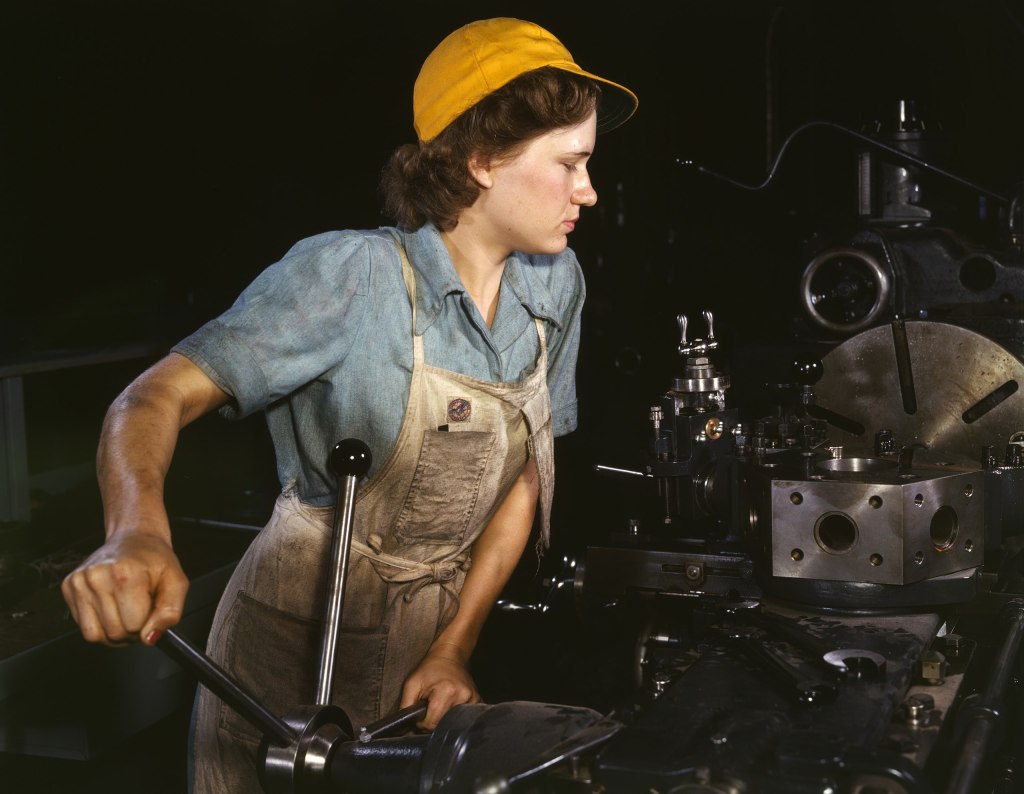
These new women were given basic training as welders, electricians, pipe fitters, sheet metal workers, truck drivers, and crane operators. More advanced training was reserved for men unless the women were willing to go to classes outside of their 10 hour, 6 day work weeks. Few did. The shops with the greatest influx of women were the Shopfitters (doing preassembly of pieces for the ships) and Ordnance (assembling the gunsights). It wasn’t until June 1944 that a few women with advanced ratings in welding, electrical and sheetmetal work were allowed to work directly on the ships. Few women were promoted into management and then they were only allowed to supervise other women.
By 1944 there was a separate clothing shop on site with the safety clothing and shoes in women’s sizes needed for their work. They were required to cover their hair with caps, wear regulation overalls and low heeled shoes. Because so many women left the job in the first 2 weeks, female counselors were hired to help the women adjust and increase retention. Over the war years, women began to prove themselves competent in the jobs and even had a better safety record with almost half the number of work related injuries per million man hours.
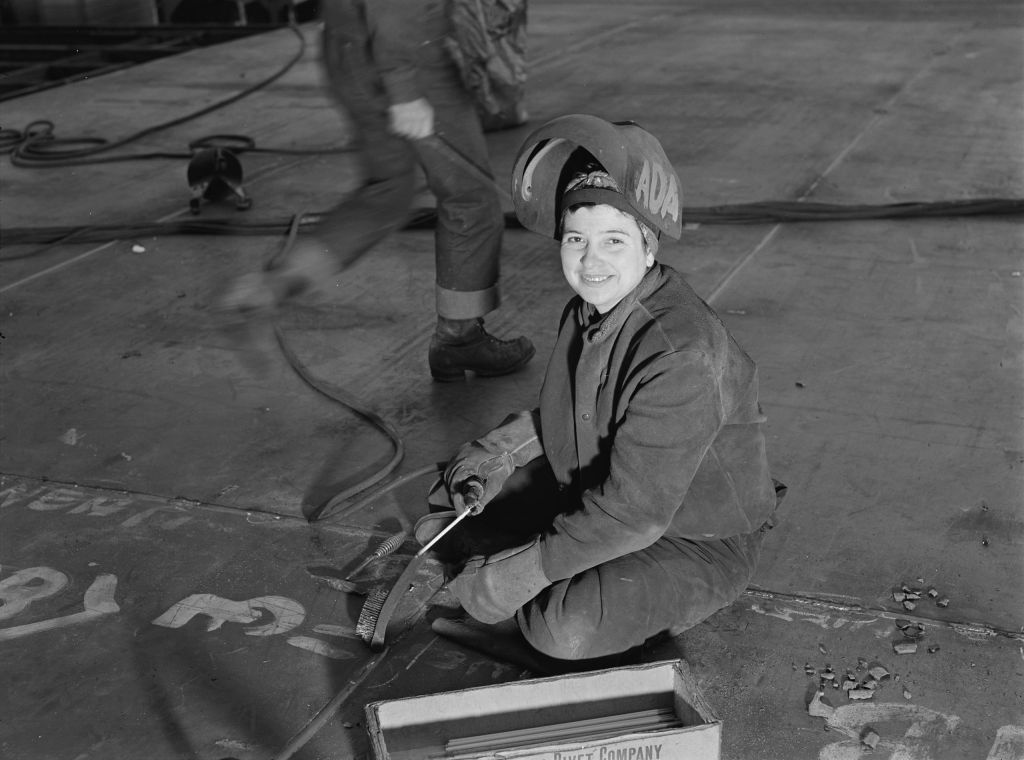
A “Wendy the Welder” at the Richmond Shipyards, Ann Rosener, U.S. Office of War Information
After The War
Because they all knew the jobs were temporary when hired, many women left as the war was winding down. The Yard was still producing aircraft carriers and had a particularly difficult time keeping enough staff in 1945. When the men began coming home, that all changed. Laws gave preferences to returning veterans and by 1946 even the flag shop had an all male staff. In August of 1947 the Yard was 64% veteran. None of the women hired into traditionally male roles remained.
Women were expected to do their duty and then step back into their traditional female roles. Staying in one of those jobs would have meant taking a job away from one of the servicemen who risked their lives for freedom. Some women were happy to return to their previous jobs and homemaker roles, but a poll showed the majority would have preferred to keep their jobs. It took the feminist movement and the second iconic Rosie to lead to more permanent changes in women’s employment.
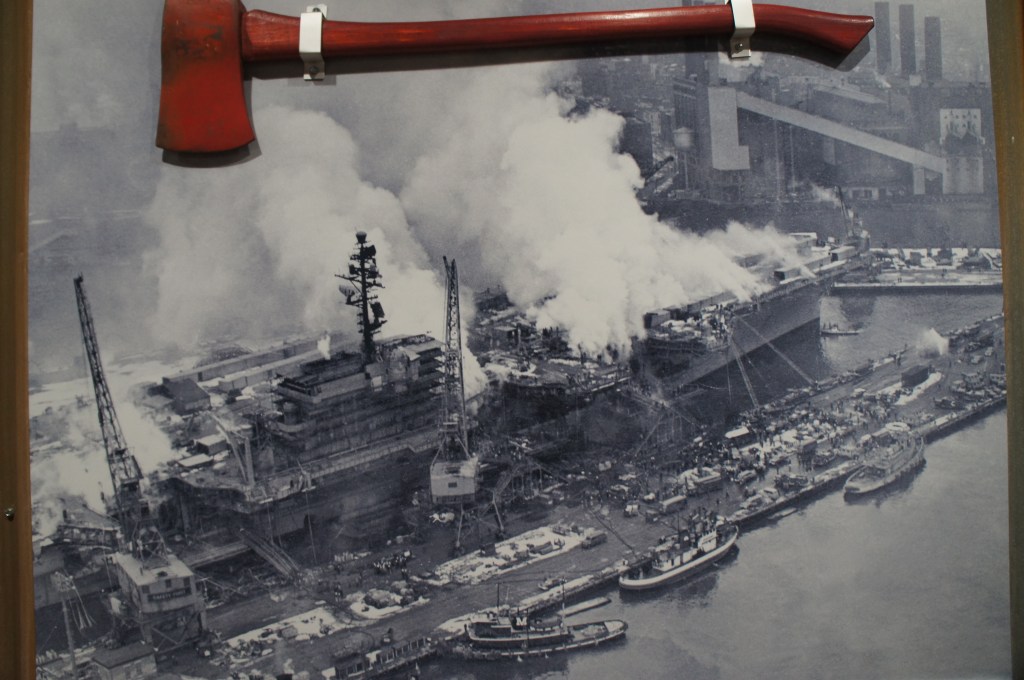
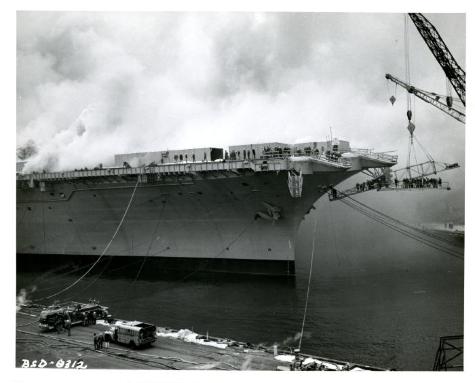
The USS Consitution fire, 1960, Associated Press, as displayed at the Brooklyn Navy Yard Museum
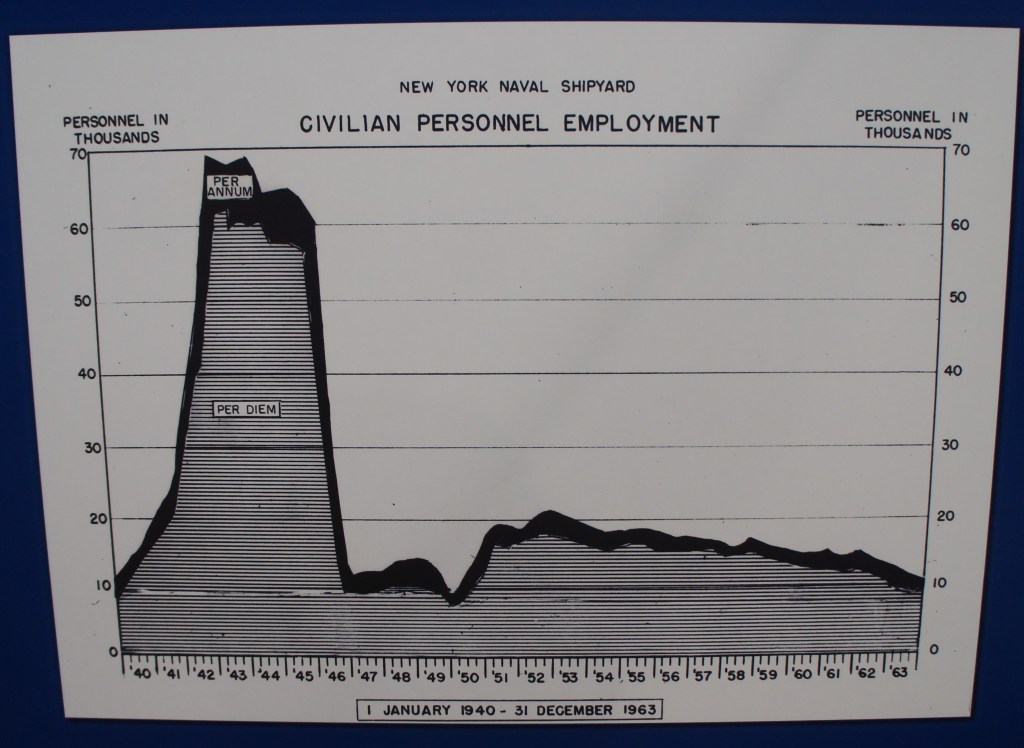
In my novel, Breathing Water, Tony’s father works at the Brooklyn Navy Yard, along with ~70,000 others during the WWII peak and ~10,000 others during peacetime. They mostly built battleships and aircraft carriers and did repairs on any number of other types of ships. The USS Arizona (sunk in Pearl Harbor) and the USS Missouri (where the peace treaty with Japan was signed) were both built there.
Employment statistics from the Brooklyn Navy Yard Museum
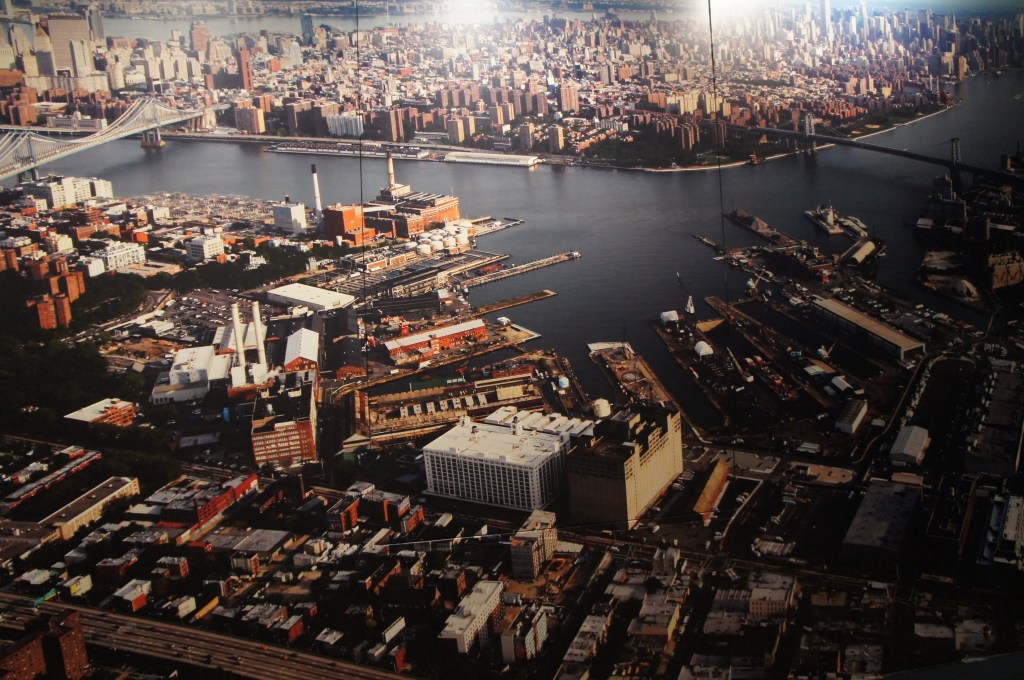
As ships became larger, it became trickier for them to navigate the currents of the East River and under bridges. In 1960, a disaster at the Brooklyn Navy Yard tarnished its previously stellar reputation, making it easier for the Navy to close this site as they turned to private shipyards. The Brooklyn Navy Yard was decommissioned in 1966. It’s funny that the fire at the USS Constellation is not better known, even though it played constantly on the news, as in modern day disasters, and it had such a large impact on so many people in the 1960s.
As ships became larger, it became trickier for them to navigate the currents of the East River and under bridges.
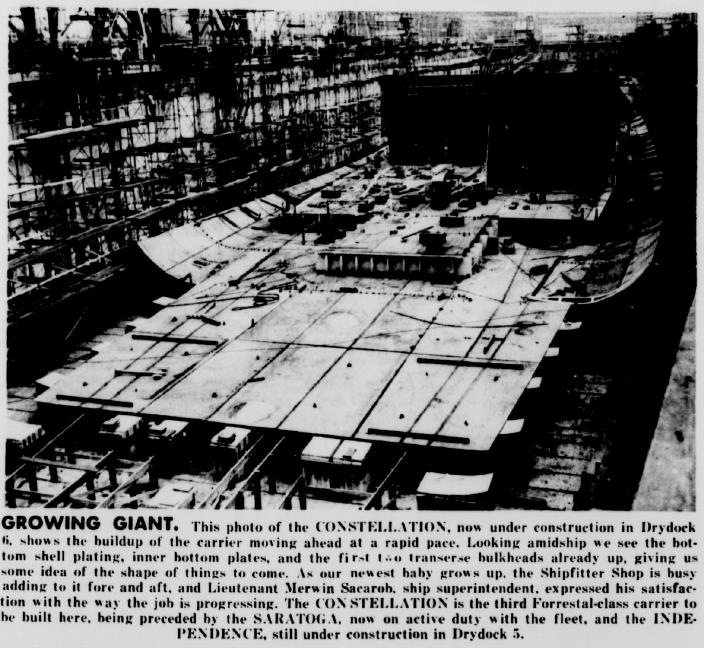
The disaster started with something very small, and then Murphy’s Law kicked in. An 1800 pound steel plate was resting on a pallet on the deck of the nearly completed USS Constellation. It would be the largest conventional aircraft carrier in the fleet and, after three years, was only a few months from completion. The ship was over 1000 feet long, or as long as 5 city blocks, and as high as a 22 story building, with room for 85 airplanes and over 4000 crew members.
Early stages of construction in Drydock 6, The Shipworker Volume XVL#49, Dec. 6, 1957 (Left), and installation of boiler #1, The Shipworker Volume XIX#46, Dec. 9, 1960, shortly before the fire. The Shipworker collection; MC/63; Brooklyn Navy Yard Development Corporation Archives, Brooklyn, NY.
A forklift operator moving a metal trash barrel on the deck bumped it into the metal plate. The plate shifted and knocked the spigot off a diesel fuel tank, leaking about 500 gallons of flammable liquid onto the deck. The fuel worked its way into lower decks where multiple crews were cutting and welding metal. A fire was triggered, but was not able to be quickly contained because the carrier was full of wood scaffolding and other sources of flammable liquids. When the fire grew out of control, over 3000 blue-collar workers were within the structure.
The fire department had to deal with an immense structure full of unlit, narrow passageways and they required self-contained breathing apparatuses. Beyond the extensive fire and smoke, the metal of the ship became so hot it melted the rubber on their boots and turned the hose water to steam, forcing the firefighters back. They had to wait to approach and repeat the wetting cycle until the metal was cool enough to proceed. The fire was so large that firefighters were called in from all over the City, including trainees from a nearby fire training school.
So much water was poured into the ship that it began to list to the starboard side by 4 degrees. Once it reached 5 degrees, it wouldn’t be safe for the firefighters to continue, so the decision was made to open seacocks on the port side. Enough water was let in to reduce it to a 2 degree list and thankfully no workers were harmed by doing so. To make matters worse, it was especially frigid for that time of year, at 11oF, and it began snowing during the operations, making it harder for everyone.
Rescue operations saved most of the men. They escaped by jumping onto barges or directly into the icy water, or by barricading themselves in airtight compartments, hoping someone would reach them in time. Rescuers moved along the hull listening for tapping, then cut through the 2.5 inch steel to get them out. They made creative use of ladder trucks and cranes because the ship was so tall. Oxygen, resuscitators and inhalers were in short supply as regional hospitals didn’t have enough to for all the injured. 70 pieces of equipment, 350 firefighters and 65 hoses were used to put out the fire which took 12 hours to contain and another 5 hours to completely put out. Radio and TV provided detailed reports to the City throughout the day and night as many families worried about their loved ones.
Multiple men described it as a living hell and by the end, 50 of the workers had lost their lives. Their names are commemorated on the plaque below. Another 330 employees and 40 firefighters were injured in the conflagration.
Memorial outside Building 92 at the Brooklyn Navy Yard
In true Murphy-style, the New York Fire Department had much more than this one disaster to deal with, as this was only the second of four very large fire/disasters they put out within a week or so. The first happened 3 days earlier and some of the men helping at the USS Constellation fire had not quite recovered from the trials of that disaster. On December 16, United flight 826 and TWA flight 266 collided in low visibility conditions over Brooklyn, with one crashing into the Park Slope neighborhood, just 2 miles away from the Navy Yard, and another into Staten Island. 128 passengers and 6 people on the ground were killed. Days after the Constellation fire, a lumber yard in Williamsburg and a gas station in Coney Island caused 8 and 4 alarm fires, respectively, taxing a weary, but dedicated NYFD. Check out this real time footage of the first two catastrophes below and this NYFD document with lots of photos and details from the Constellation.
The USS Constellation was eventually repaired and completed in October of 1961, at an additional cost of $75 million. Other fires would happen on board, but none would be as devastating as that at the Brooklyn Navy Yard. It was in service for 41 years when tens of thousands of Navy personnel walked its decks. It was in commission during the Vietnam and Gulf wars and projected American might across the world. President Ronald Reagan designated it “America’s Flagship” during a visit, but it was usually referred to as “Connie” by those who lived on it. The USS Constellation was also the site of a sit-in protest by Black sailors in 1972, protesting systemic racism within the Navy. A Disney children’s movie, Tiger Cruise, was filmed on board. After decommissioning, it was sold for scrap and disassembled in 2015-17.
The USS Constellation Aircraft Carrier. Decommissioning ceremony on the right. Photo credit: US Navy.
The Brooklyn Navy Yard was once New York’s largest employer. During peak employment in WWII the largely white male workforce became 10% female, including as pipe-fitters, electricians, welders and sheet metal workers. Look for an upcoming article about “Rosie the Riveter” to learn more. The Navy also started employing minorities during WWII, mostly African Americans, to make up 8% of the workforce. After hostilities ended, the women all lost their jobs, but minority employment continued to inch up to 20% by the time the Yard closed.
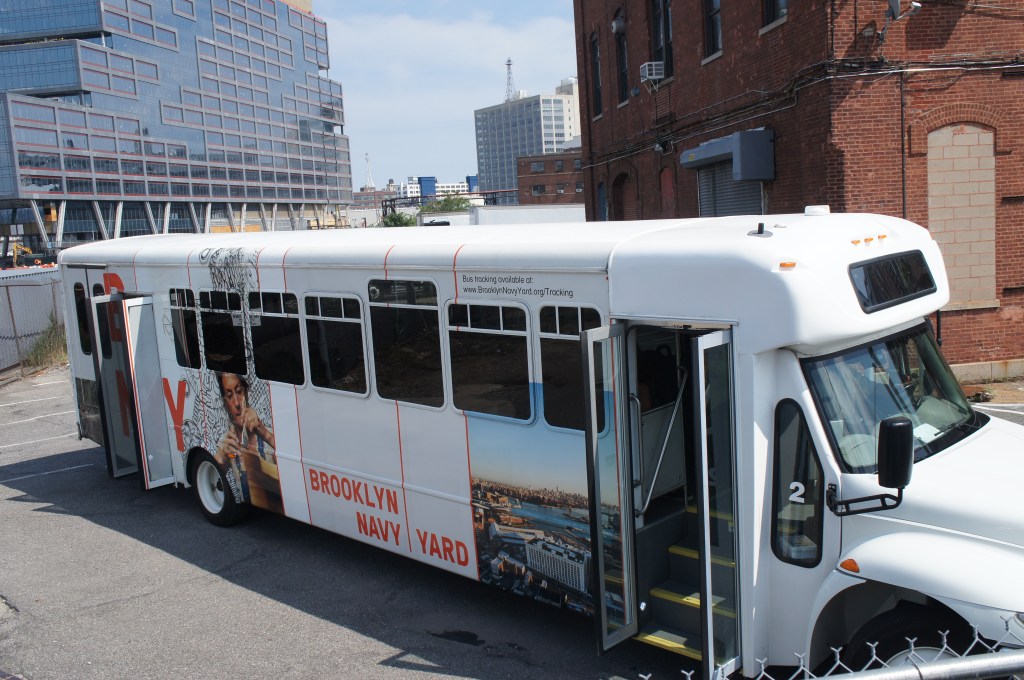
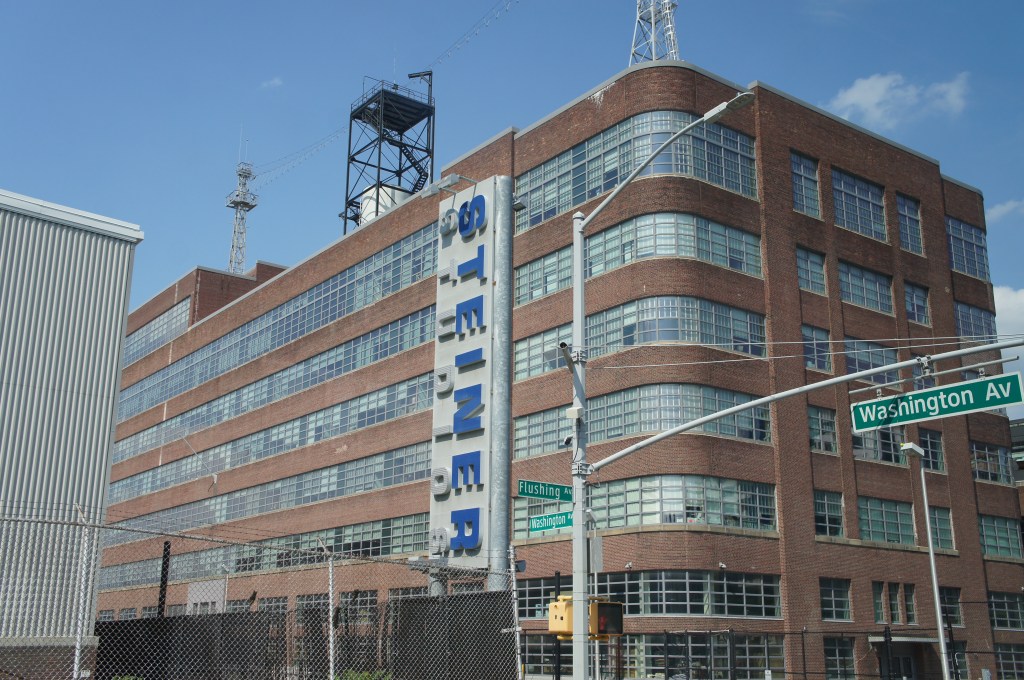
New York City was eager to use the 300+ acre site to generate other jobs and they negotiated purchase of the site from the US government. Now the Brooklyn Navy Yard Development Corporation is a non-profit organization promoting small business development onsite, currently including 450+ businesses employing 11,000 people for a 2.5 billion dollar economic impact. Steiner Studios is the largest and most sophisticated studio complex outside of Hollywood and a wide range of other businesses thrive there. You can take a guided tour of the historic parts of the old Navy Yard today.
Brooklyn Navy Yard Tour- 2018
Donna Barten is a novelist and scientist awaiting publication of her first novel, Breathing Water.
Dating became more formalized in the 1950s and also less chaperoned than in earlier generations. Although dating originated at the turn of the century, it continued to evolve away from courting rituals where men interacted with potential spouses in the girl’s parents home or in very public venues. Labor of Love: The Invention of Dating by Moira Weigel.
“Movie manners: While the fellow buys the tickets, the girl steps aside and looks at the stills outside to avoid the boy any embarrassment he may feel at the ticket window. Once inside, the girl follows the usher to their seats, and the fellow follows the girl. If there is no usher, the boy precedes the girl down the aisle, finds two seats, and steps aside so that the girl may be seated first; he then follows and seats himself beside her. If the girl is wearing a coat or jacket, the fellow helps her out of it and arranges it comfortably over the back of her seat. Then he removes his outer coat and hat and scarf and either places them under his seat or holds them in his lap.
“The boy may hold the girl’s hand if she has no objection, or place his arm over the back of her seat. Such actions do not go beyond socially acceptable behavior. They may whisper their reactions to the picture, or comment to each other about the characters or the plot, so long as they neither embarrass each other nor annoy their neighbors.“
The boy would pay for every date in anticipation of his future role as sole provider in marriage. Early critics of the new practice of dating suggested that this was equivalent to prostitution, with a meal and entertainment being paid instead of cash. The criticism was dropped, but there was an inherent sense that a girl owed a boy “something” for what he provided. A girl’s family wanted to meet the boys she dated, but the boy’s families didn’t expect to meet his date until things were serious and likely to head to marriage. Girls had to wait to be asked on a date, and utilized various strategies to help make that happen with a shy boy. If a girl was considered too smart, a “brain,” she might be intimidating to boys and was expected to play dumb.
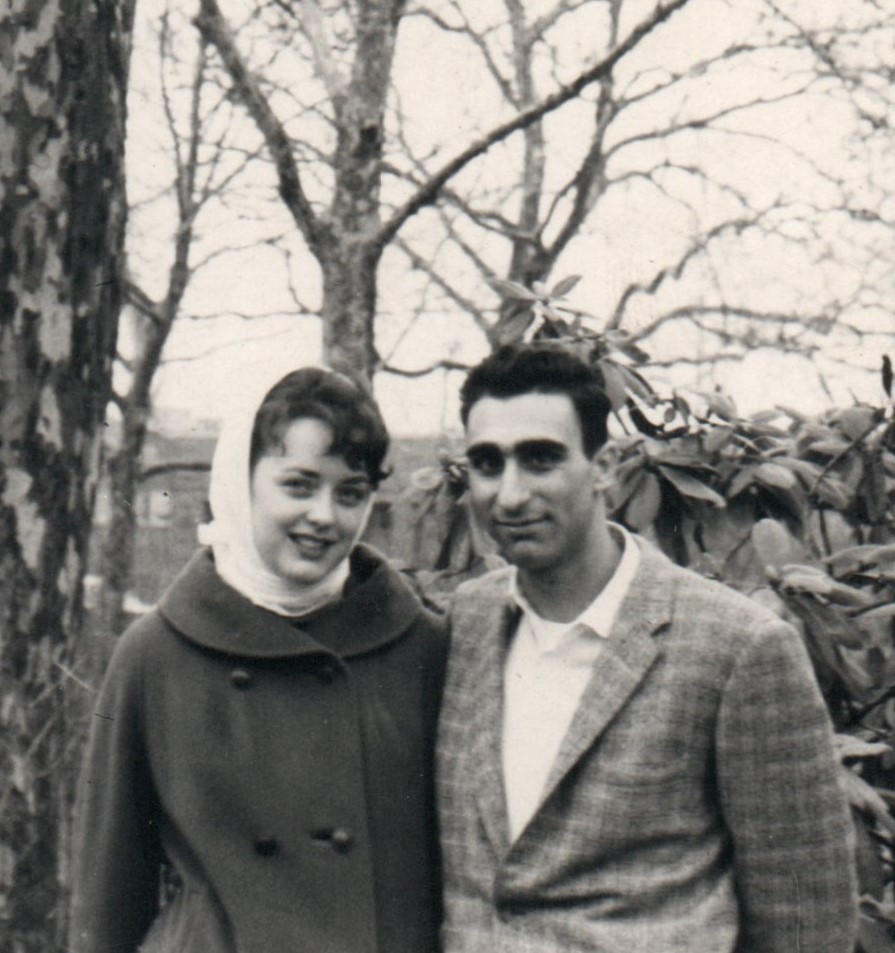
The author’s parents going steady 1959
Rock N Roll music was growing up, bothering parents with their brash sounds and superstars such as Elvis Presley and James Brown who moved their hips in a sexually suggestive manner. Articles warning parents about the new “teen-ager” culture were featured in popular magazines. A boy was particularly cool if he was a good dancer and the Lindy Hop was one of the favorites of the time.
“Adam began by rapidly twirling his partner around. This worked best if she was wearing crinolines, those scratchy, layer cake-like underslips meant to be seen, so fashionable among teenage girls at the time. Then he forcibly swung them away from himself and across the floor. There was a 3 or 4 beat pause so that he could snap his fingers in a cool offhand way, making sure the other dancers had cleared enough space between them. Then the girl ran directly toward him at top speed. At the last second before they crashed together, he grabbed her and lifted her first to his left side and then to his right, up in the air and down between his legs, and then up in the air again for the grand finale. It required an athletic partner.” Trying to Be Cool– Growing up in the 1950s Leo Braudy
Dangerous Dating
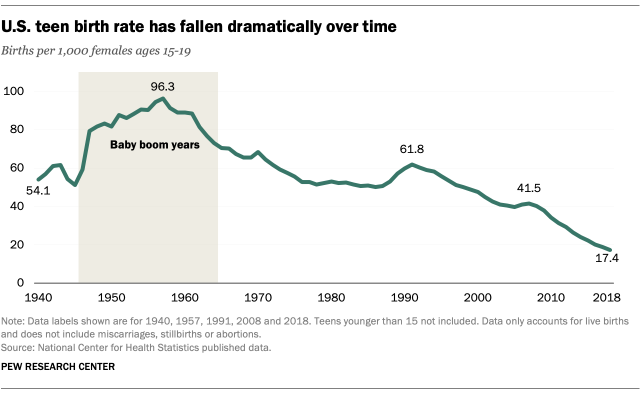
We think if it all as quaint now, but the 50s and early 60s was the time of highest teenage pregnancy in the US, despite all the warnings given to girls (without any formal sex education beyond books like Peyton Place).
This was also the period of earliest marriages in US history. At age 19, 42% of girls were married, and by age 24, it was 70%. Eventually 93% would marry and most would stay home to raise their children. (New Passages– Mapping Your Life Across Time by Gail Sheehy)
Shotgun marriages were common to prevent shame and illegitimate birth. In the following decade and beyond, the number of illegitimate births, especially among teen mothers, would rise significantly, presumably because of fewer unwanted marriages as the stigma of single mothers decreased.
The above statistics demonstrate the real danger of unexpected pregnancy leading to a sudden marriage in the 50s and early 60s. At the time, the even newer practice of “going steady” was used in explanation. So much so, that the Catholic Church, privy to the extent of hastily-arranged marriages, publically campaigned against the “pagan” practice of going steady.
“While steady dating is often construed as ‘marriage in miniature,’ the speaker [The Rev. John R. Cavanagh]said, ‘it is not preparation for marriage’ when the practice is devoted to individual pleasure.” Parents were urged “to ‘do everything in their power’ to prevent the going steady of teen-agers and pre-teen-agers. He declared, ‘It limits their friendships and if continued is likely to promote at best a brother-sister relationship in marriage. In addition, it may lead to a consummated sin, even in their early teens.’”NYTimes March 20, 1957
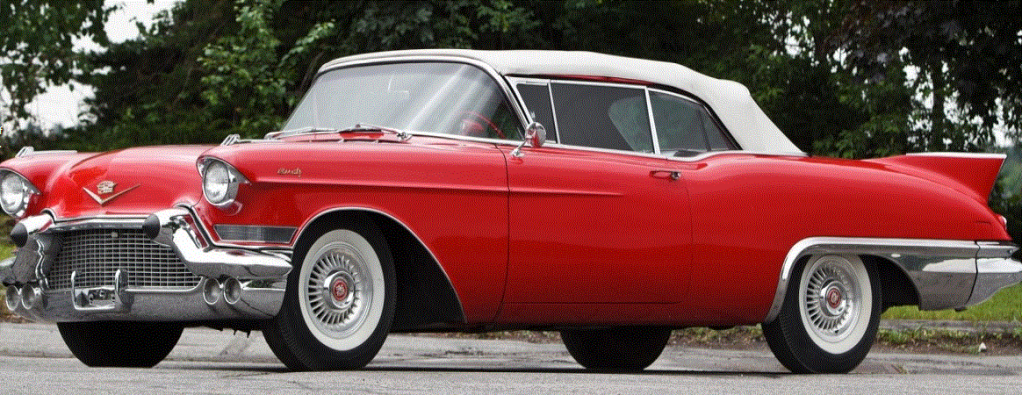
A 1957 Cadillac-Nice By Akote
Parking in cars was another factor leading to unexpected pregnancy. Many boys and their families had the means in the post-WWII prosperity to own cars. After some public activity, often associated with a church or synagogue, parking required significant self-control when boys and girls had couch-sized spaces for necking and petting. Sexual promiscuity in boys was tolerated, but was strictly taboo for “nice” girls. This double-standard meant that preventing pregnancy was the responsibility of the girl.
“Since time immemorial the woman has been called on to be the one who maintains sexual standards in a relationship. So the burden of the situation rests primarily on her. If she allows premarital intercourse, it is she who is generally considered the fool. If a pregnancy ensues, it is the girl who is ‘in trouble.‘
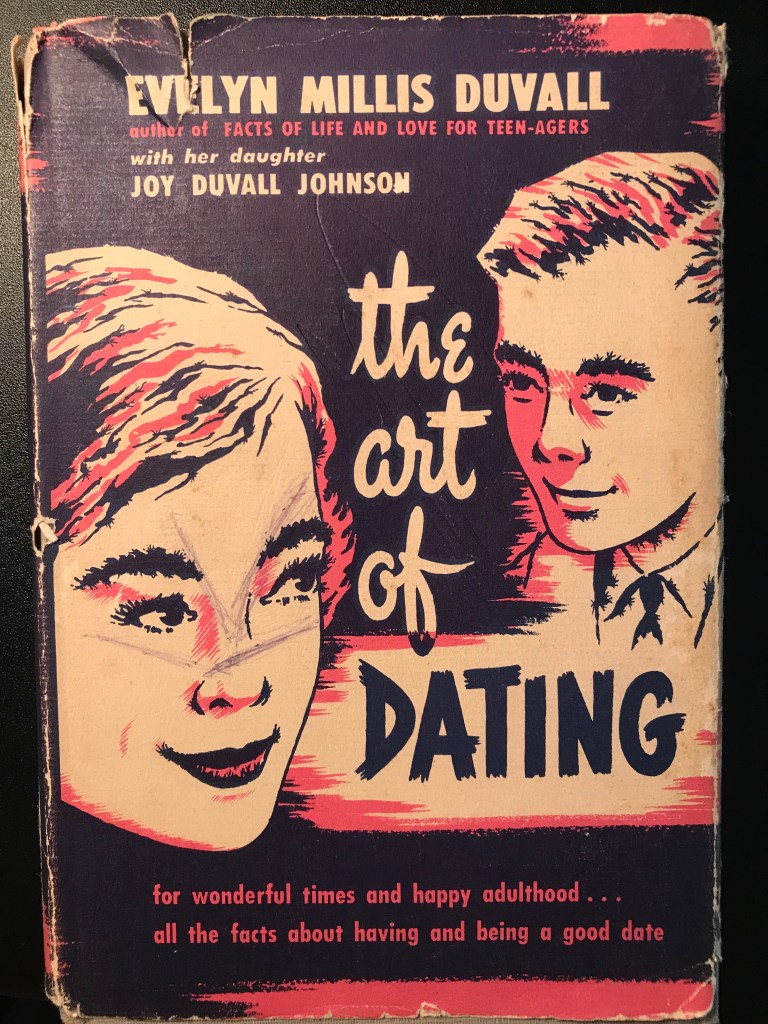
“What does the guy think if his girl gets pregnant? He may realize that he does not really love the girl. He may wonder if perhaps she has trapped him into this predicament. He may be haunted by the question, ‘if she went all the way with me, how can I be sure there have not been others?’ Few fellows want to get stuck with ‘a tramp.’” The Art of Dating
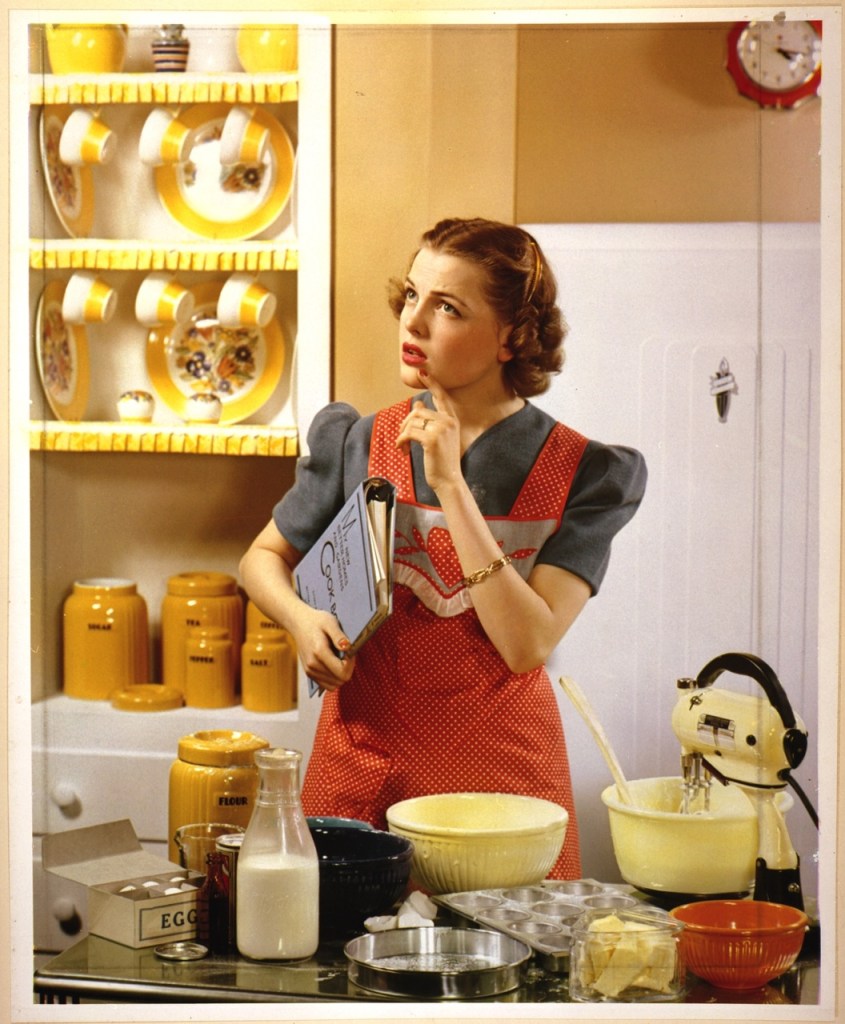
“So now she was packing, saying goodbye to her apartment and to New York and to the job that she had never really liked enough to miss now. How strange it would be to lie in bed every morning until ten o’clock, and to be able to cut out recipes from the newspaper and make things that Ronnie liked, and to know that there was someone who would come home to her every evening, who would want to come home to her, who would direct himself to his home as a bird flies south in winter, instinctively, for warmth and love and the life he needed. Things that had never seemed so interesting before: tablecloths in store windows, embroidered sheets, silverware, now took on a great significance.“
Modernette Kitchen by MasterCraft c.1950s-1960s
It was the next generation that would rebel against these expectations for both men and women and open up new opportunities for women beyond the home. But this generation, sometimes called the Silent Generation, was a necessary bridge between the more conservative past and the sexual revolution and feminism of the sixties and seventies to come.



































 Donna Barten
