
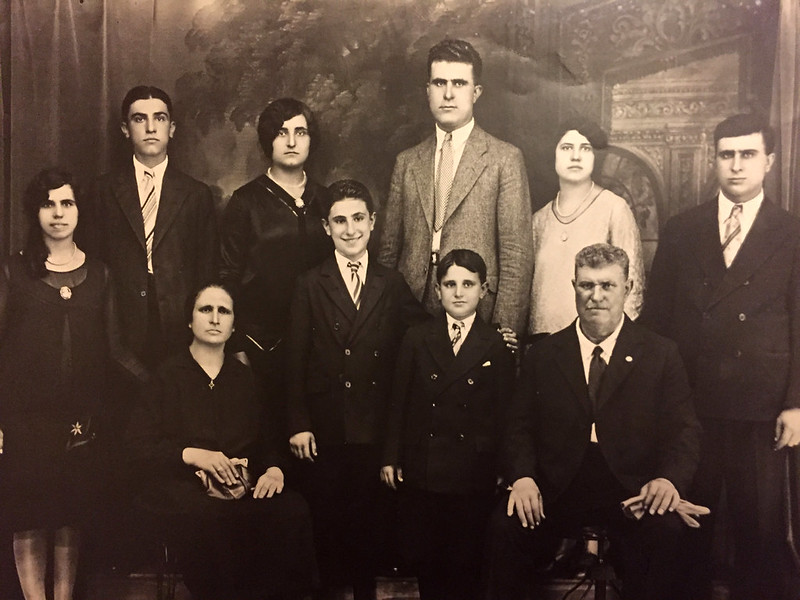
Old photographs figure large in my second novel, Imprint and Inheritance. Colleen shows Julia old photos from 1920 – 1960 to reminisce, and one particular photo is the inciting incident for the novel. Most were black and white, but the earliest photos were sepia-toned. As I wrote, I wondered if black-and-white photos turned sepia with age, or if they were created that way.
The word sepia comes from the Greek word for an ink extracted from European common cuttlefish (Sepia officinalis), of the reddish-brown hue. Turns out these are fascinating animals. Since cuttlefish squirt ink and camouflage themselves by moving pigment to different parts of their body, it made sense for early cultures to extract ink for their own use.
Sepia ink was used by writers and artists for centuries, including by Leonardo DaVinci.

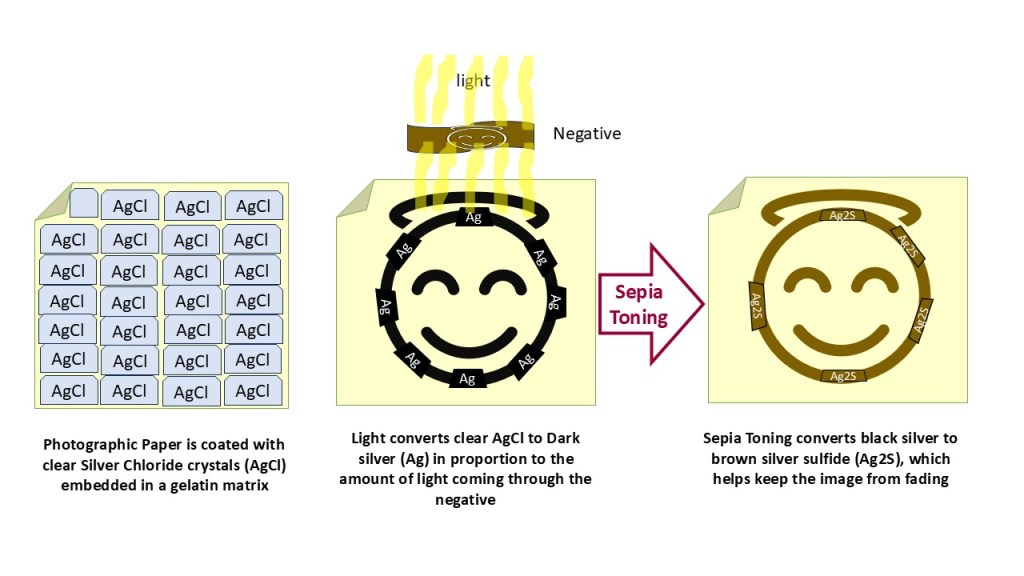
It turns out sepia toning was a separate step while printing photographs from the 1880s to the early 1900s. The photos started out black and white, but were toned to sepia by the photographer before the customer ever saw it. Not only did Sepia toning make the images warmer and more inviting (increasing in warmth with aging), but it fixed the photographic image on the paper for 50% longer. Because photographs were a luxury items and families usually had just a few to record their whole lives, reduced fading was worth the extra step.
Interestingly, the toning process can be done in the daylight once the prints are made in the darkroom. Initially, that was helpful when sodium sulfide was used, as it’s what gives rotten eggs their odor. Here’s a basic diagram of how silver particles (embedded within gelatin on the paper surface) are transformed during printing and sepia toning.
Nowadays film hobbyists and artists use thiourea for sepia toning, which doesn’t smell as much, but it’s still better used outside of the darkroom. Here’s a demo video if you’re curious how it’s done.
As photographic processes improved over time, sepia toning was no longer necessary to stabilize the image. As a result, black-and-white photos dominated from the 1930s through the 1960s. Color photography was available as early as the 1930s, but was not as common as hand coloration of black-and-white photos. In the 1970s, color dominated the printing market when it became more affordable.

Hand colored black-and-white photo of my father as a boy, approx 1944
Photographers still do sepia toning for artistic reasons, adding just a hint of sepia to a black-and-white photo, or completely converting to sepia of different intensities and tonalities. But because of its history, sepia tones evoke a sense of nostalgia. Nowadays you can create sepia toned images on your digital camera, with a bit of finessing on your smartphone, or after the fact using Lightroom/Photoshop with the click of a few buttons.



Coney Island- 2023- Click to switch to black-and-white or sepia-tone. Which gives the greatest atmosphere of an earlier time?
Note: Photos are from the author’s family collection and may not be used without permission. The DaVinci image is from the public domain at Wikipedia.
 Donna Barten
Photographs! What nostalgia I felt reading this as I recalled my father “colorizing” our black and white photos. Gary inherited family photos from the late 1800’s/early 1900’s and had them beautifully restored. We have a framed tintype along with the restored photo. And yes, we have some sepia photos. I have the many photos my mom sent to my dad during the 3 years he was away in WWII. Many of them are of my older brother and include comments on the back about his smiles and how he turned over on his own. They capture my mom’s sense of humor like posing in her sister’s fur coat and pretending it was hers. After my uncle died a few years ago, I requested his huge photo collection – cartons and cartons of pictures that I have been slowly sorting through, Most of them are being thrown out – photos of flowers, people we don’t know, foreign landmarks, holiday meals, etc. Embarrassingly, we came across some “naughty” pics of my uncle and his wife that we would rather have not seen. However, it pleased me to know that they were so happy together. Every once in awhile I find a gem – a photo of my mom when she was young or a picture of my grandmother that I had never seen before. Those are worth the tedium of sorting through floral, food, and travel pics.
Thanks for the interesting information in your piece, Donna:-)
LikeLike